
Introduction
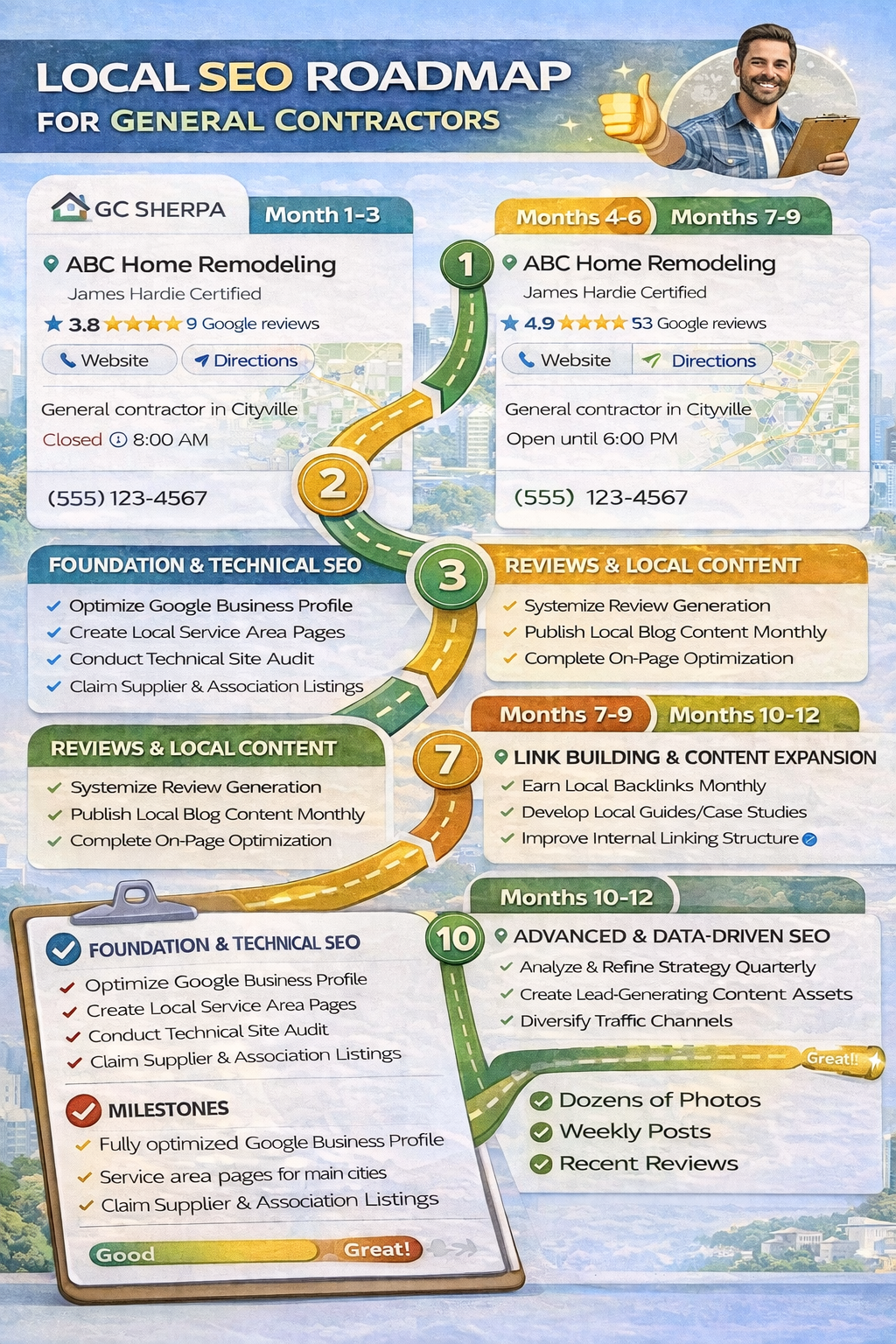
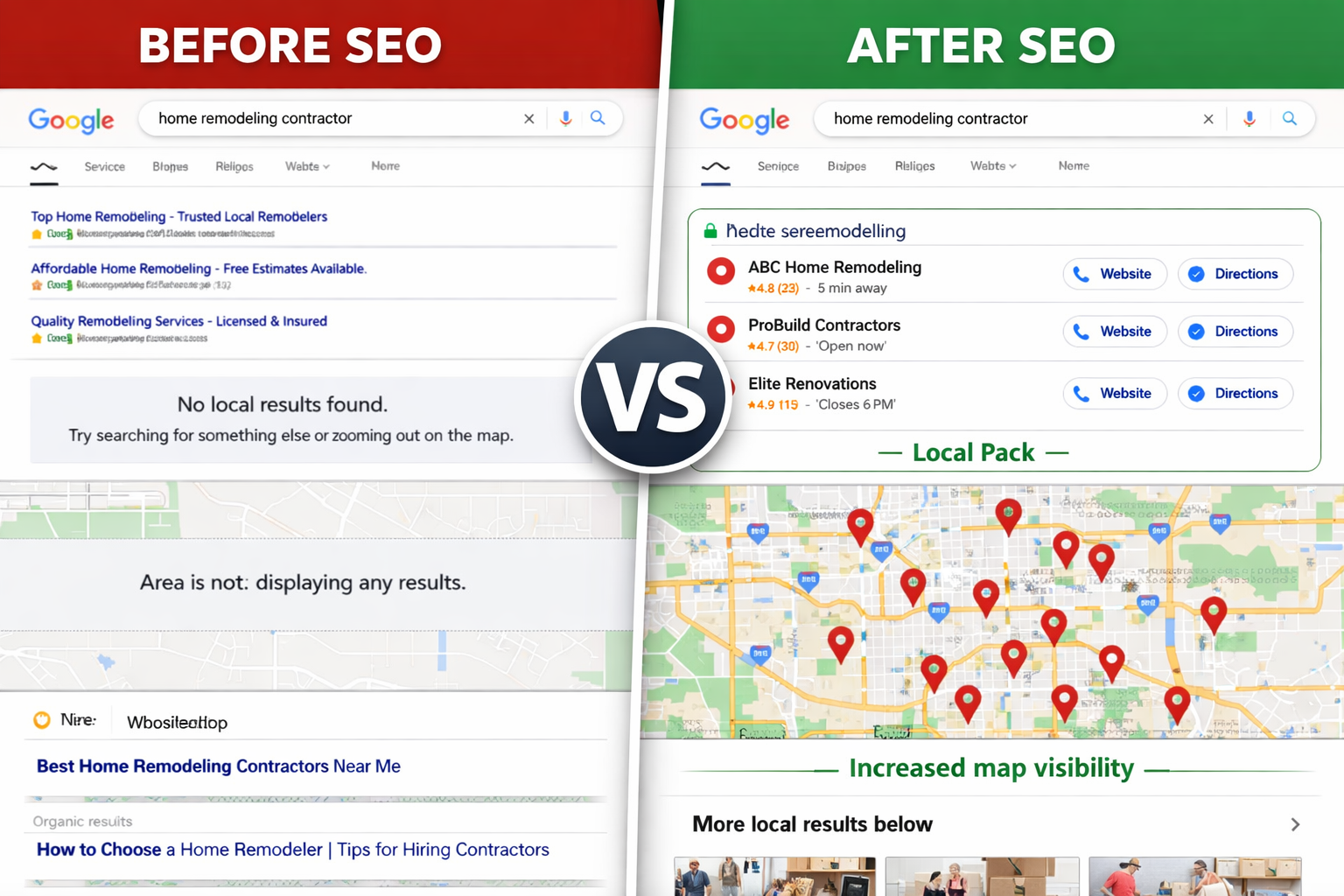
Local SEO is the process of optimizing your online presence to attract customers from specific geographic areas where you operate. For general contractors, this means appearing in Google’s local pack, Maps results, and organic listings when homeowners search for services like “kitchen remodeler near me” or “general contractor in [city name].”
Unlike national SEO strategies that target broad audiences, local SEO focuses on dominating search results in your service radius. This approach is essential for contractors because most residential and commercial construction projects require in-person consultations, on-site work, and local licensing compliance.
This guide provides a comprehensive, actionable roadmap to build visibility in your target markets, generate consistent lead flow, and establish your contracting business as the go-to option in your community.
Key Takeaways
- Google Business Profile optimization is your foundation – A fully completed, regularly updated profile with photos, posts, and responses dramatically increases your visibility in local search and Maps results.
- Location-specific pages outperform generic content – Creating dedicated service area pages with unique, locally relevant content helps you rank for searches in multiple cities and neighborhoods.
- Reviews directly impact ranking and conversion – Consistent 5-star reviews with detailed responses signal trustworthiness to both Google’s algorithm and potential customers evaluating your services.
- Citations and backlinks build local authority – Accurate business listings across directories and links from local organizations strengthen your domain authority and geographic relevance.
- Tracking performance identifies growth opportunities – Monitoring keyword rankings, Google Business insights, and lead sources reveals which tactics generate ROI and where to focus your efforts.
- Technical SEO creates the infrastructure for success – Fast loading speeds, mobile optimization, and proper schema markup ensure search engines can crawl, understand, and rank your website effectively.
What Is Local SEO for General Contractors?
Local SEO is the practice of optimizing your digital presence to rank prominently when potential customers in your service area search for construction and remodeling services. It encompasses everything from your Google Business Profile and website content to online reviews, citations, and backlinks from local sources.
For general contractors, local SEO matters because your customers exist within a defined geographic radius. Unlike e-commerce businesses that can serve customers anywhere, you need to attract homeowners and property managers within 15-50 miles of your office who are actively looking for contractors.
The primary goal is achieving visibility in three key areas: Google’s local pack (the map listings that appear at the top of search results), Google Maps itself, and the organic search results below the local pack. Success in these areas translates directly to phone calls, form submissions, and project estimates.
Why General Contractors Must Prioritize Local SEO
The construction industry faces unique digital marketing challenges. Most contractors rely heavily on referrals and word-of-mouth, which limits growth potential. Local SEO creates a predictable, scalable system for generating new leads without depending solely on past clients.
Consider the buyer’s journey for construction services. Homeowners rarely hire the first contractor they find. They research multiple options, read reviews, compare portfolios, and evaluate professionalism based on online presence. If your business doesn’t appear in their initial search results, you’ve already lost the opportunity to compete for their project.
Research shows that 76% of people who search for something nearby on their smartphone visit a business within 24 hours. For high-value services like home remodeling, basement finishing, or commercial buildouts, capturing these local searches can mean the difference between a slow month and a fully booked schedule.
Local SEO also levels the playing field. A small, specialized contractor with excellent local optimization can outrank larger competitors who neglect their digital presence. You don’t need massive marketing budgets—you need strategic execution.
Step 1: Claim and Optimize Your Google Business Profile
Your Google Business Profile (formerly Google My Business) is the single most critical element of your local SEO strategy. This free listing controls how your business appears in Google Search and Maps, and it’s often the first impression potential customers have of your company.
Complete Every Section of Your Profile
Start by claiming your listing at google.com/business if you haven’t already. Google will verify your business through a postcard sent to your physical address, a phone call, or email verification depending on your business type and history.
Once verified, fill out every available field completely. Include your business name exactly as it appears on your signage and legal documents. Add your primary phone number (preferably a local number, not a toll-free line). Enter your service area if you operate from a home office, or your street address if customers visit your location.
Select the most specific business categories available. Your primary category should be “General Contractor,” but you can add secondary categories like “Remodeling Contractor,” “Kitchen Remodeler,” “Bathroom Remodeler,” or “Deck Builder” based on your specializations. Categories directly influence which searches trigger your profile.
Write a Compelling Business Description
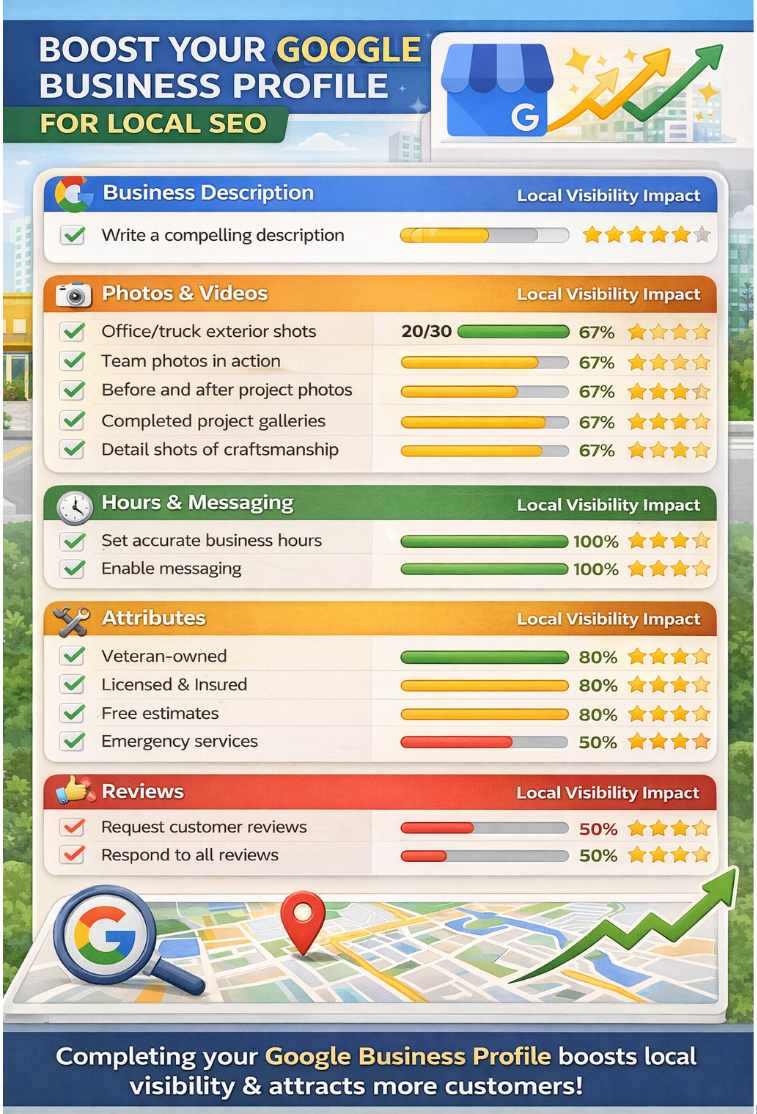
Your business description should clearly explain what you do, who you serve, and what makes you different. Use natural language that incorporates location names and service keywords without keyword stuffing.
Example: “Family-owned general contractor serving [City] and surrounding communities since 2010. We specialize in custom home remodels, kitchen renovations, bathroom updates, and additions. Our licensed team delivers quality craftsmanship, transparent pricing, and projects completed on time.”
Add High-Quality Photos and Videos
Visual content dramatically increases engagement with your profile. Google reports that businesses with photos receive 42% more requests for directions and 35% more clicks to their websites compared to those without images.
Upload photos in these categories: exterior shots of your office or truck, team photos showing your crew in action, before-and-after project photos, completed project galleries, and close-ups highlighting craftsmanship details. Aim for at least 20-30 high-resolution images initially, then add new project photos monthly.
Videos showcasing your work process, customer testimonials, or time-lapses of project completion add another dimension of credibility and engagement.
Set Accurate Business Hours and Attributes
Nothing frustrates potential customers more than incorrect hours. Update your regular hours, holiday hours, and any special hours for seasons when your availability changes. Enable messaging if you can respond promptly, or disable it if you can’t maintain quick reply times.
Add attributes relevant to contractors: “Veteran-owned,” “Licensed,” “Insured,” “Free estimates,” “Emergency services,” or “Eco-friendly” if applicable. These details help customers filter results and understand your business at a glance
Step 2: Build Location-Specific Website Pages
A single homepage cannot effectively target multiple cities or service areas. To rank in different locations, you need dedicated pages optimized for each geographic market you serve.
Create Service Area Pages with Unique Content
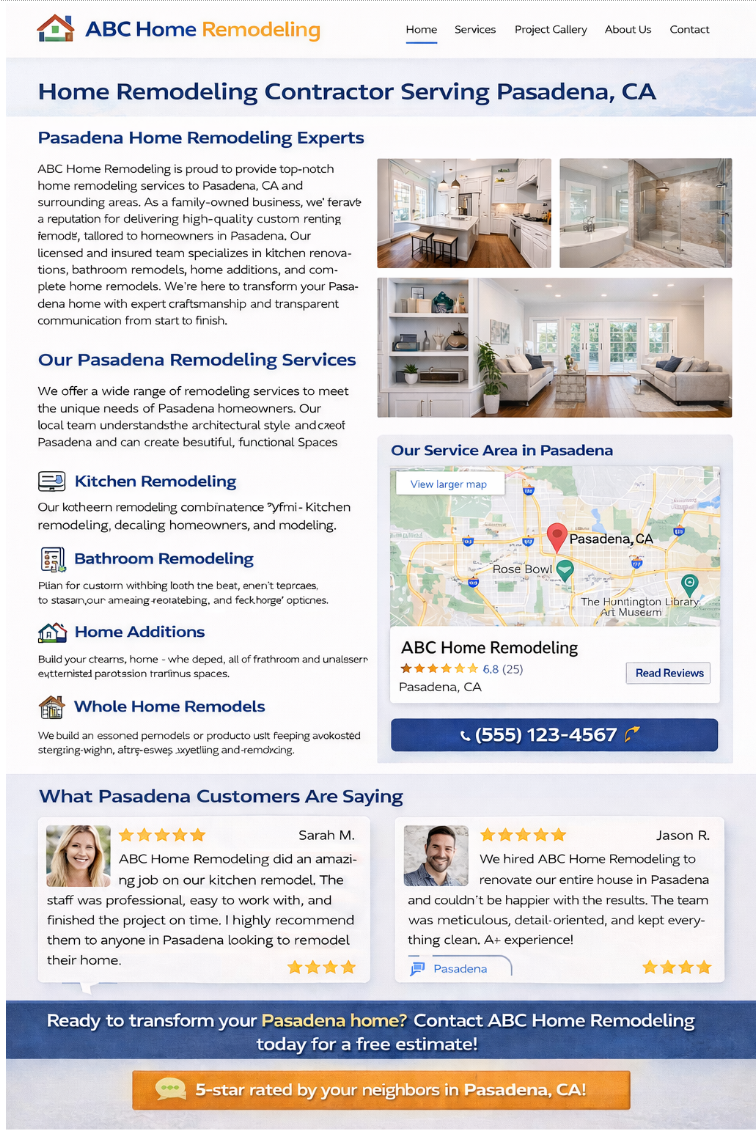
Each location page should contain genuinely useful, locally relevant information—not just the same template with city names swapped out. Google’s algorithm can detect thin, duplicated content and will penalize or ignore pages that don’t provide unique value.
Effective location pages include: an introduction explaining your services in that specific area, local market insights (average project costs, popular home styles, common renovation challenges), neighborhood-specific examples (if you’ve worked in particular subdivisions), local licensing or permit information, and customer testimonials from that city.
For example, a page targeting kitchen remodeling in Naperville, Illinois should discuss Naperville building codes, reference popular neighborhoods like Ashbury or White Eagle, mention local design trends in that market, and showcase projects you’ve completed there.
Optimize On-Page Elements for Local Search
Your page title should include both your service and location: “Kitchen Remodeling in Naperville, IL | [Company Name].” The H1 heading should mirror this structure. Use H2 and H3 subheadings that incorporate location and service variations naturally.
The URL structure should be clean and descriptive: yoursite.com/kitchen-remodeling-naperville-il. Include the city name and state in your page’s first paragraph, and mention it naturally 3-5 times throughout the content.
Add structured data markup (schema.org LocalBusiness type) to help search engines understand your geographic targeting. This code tells Google your business name, address, phone number, service areas, and business type in a format algorithms can easily parse.
Learn more about on-page seo for general contractors to ensure every element of your location pages is properly optimized.
Create Service-Specific Pages for Each Location
Beyond city pages, consider creating pages that target specific service + location combinations for your most profitable offerings. A “Bathroom Remodeling in Aurora, IL” page can capture searchers with high commercial intent who know exactly what they want.
These pages work best for services you actively promote and can support with unique content. Don’t create dozens of thin pages—build fewer pages with substantial, helpful content that genuinely serves searchers’ needs.
Step 3: Implement Technical SEO Best Practices
Technical SEO creates the foundation that allows your content and optimization efforts to succeed. Without proper technical infrastructure, even the best content may not rank.
Ensure Mobile Responsiveness and Fast Loading
Over 60% of local searches happen on mobile devices. Your website must display perfectly on smartphones and tablets, with tap-friendly buttons, readable text without zooming, and intuitive navigation.
Page speed directly impacts rankings and user experience. Test your site at PageSpeed Insights and GTmetrix. Aim for load times under 3 seconds. Common speed improvements include compressing images, enabling browser caching, minifying CSS and JavaScript, using a content delivery network (CDN), and upgrading to quality hosting.
For contractors showcasing project galleries, implement lazy loading so images load as users scroll rather than all at once. This dramatically improves perceived performance.
Fix Crawlability and Indexing Issues
Search engines must be able to access, crawl, and index your pages to rank them. Submit an XML sitemap to Google Search Console that lists all your important pages. This helps Google discover your location and service pages faster.
Check your robots.txt file to ensure it’s not accidentally blocking important pages. Review Google Search Console’s Coverage report to identify any indexing errors, redirect chains, or duplicate content issues.
Implement SSL encryption (HTTPS) if you haven’t already. Google considers HTTPS a ranking signal, and browsers display security warnings on non-secure sites, damaging trust.
For a comprehensive guide on technical optimization, review this Technical SEO Checklist covering all critical elements for contractor websites.
Structure Your Site with Logical Navigation
Your site architecture should make sense to both users and search engines. Organize pages in a clear hierarchy: homepage → service pages → location pages → blog/resources. Use descriptive navigation labels rather than vague terms like “services” or “more.”
Implement breadcrumb navigation to show users their location within your site structure. This also creates additional internal linking opportunities and helps search engines understand page relationships.
| Technical Element | Why It Matters | Target Metric |
| Mobile Responsiveness | 60%+ of local searches happen on mobile | 100% mobile-friendly score |
| Page Load Speed | Affects rankings and user bounce rate | Under 3 seconds |
| SSL Certificate | Security ranking signal and trust factor | HTTPS on all pages |
| Schema Markup | Helps search engines understand content | LocalBusiness schema implemented |
| XML Sitemap | Ensures all pages are discoverable | Submitted to Google Search Console |
Step 4: Generate and Manage Customer Reviews
Online reviews serve as social proof, influence consumer decisions, and directly impact local search rankings. Google’s algorithm considers review quantity, quality, recency, and diversity when determining local pack positions.
Build a Systematic Review Request Process
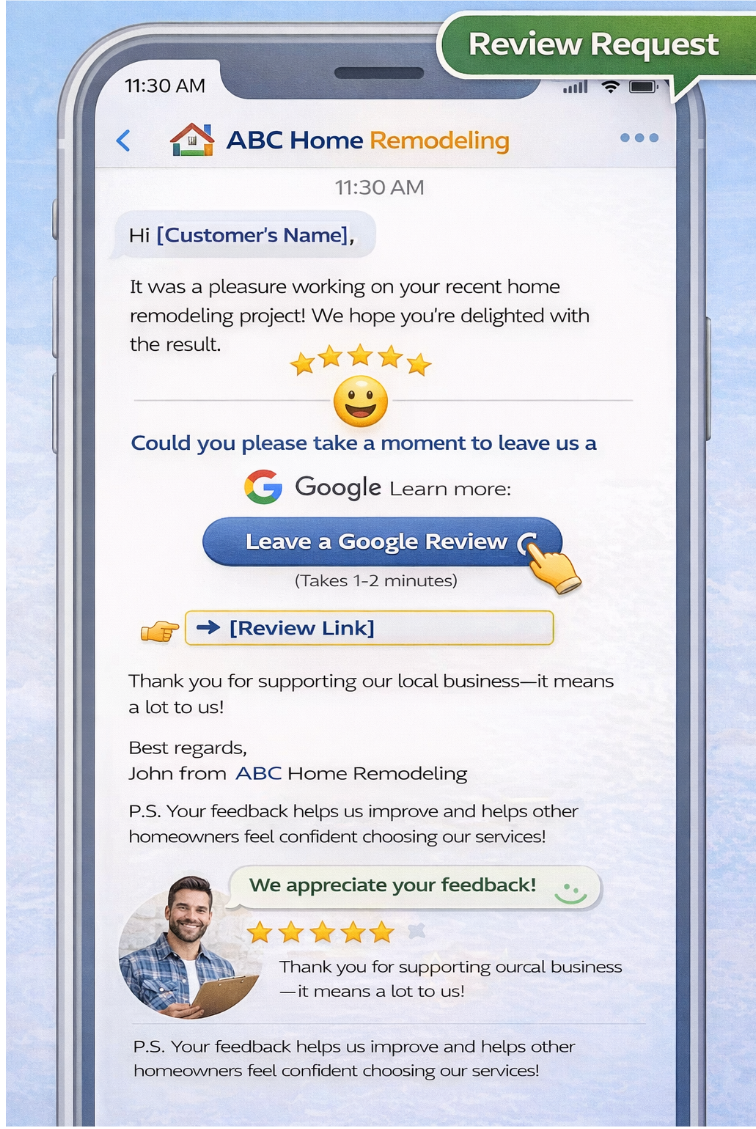
The best time to ask for a review is immediately after project completion when the customer is most satisfied. Don’t wait weeks or months—strike while the experience is fresh and positive emotions are highest.
Create a simple review request process: send a thank-you email or text message that includes a direct link to your Google Business Profile review form. Make it as easy as possible by providing the exact link rather than asking customers to search for your business.
Consider using review management software that automates requests and sends gentle reminders to customers who haven’t responded. Tools like Podium, Birdeye, or ReviewTrackers can streamline this process across multiple platforms.
Respond to Every Review
Responding to reviews—both positive and negative—demonstrates that you value customer feedback and maintain an active online presence. Thank customers for positive reviews specifically, mentioning details from their project to show authenticity.
For negative reviews, respond professionally and offer to resolve the issue offline. Avoid being defensive or argumentative. A graceful, solution-oriented response to criticism can actually improve your reputation by showing professionalism under pressure.
Example response to a positive review: “Thank you for the kind words, Sarah! We’re thrilled you’re enjoying your new kitchen. The custom cabinetry and quartz countertops turned out beautifully. It was a pleasure working with you, and we appreciate you choosing [Company Name] for your remodel.”
Diversify Reviews Across Multiple Platforms
While Google reviews carry the most weight for local SEO, reviews on other platforms strengthen your overall online reputation. Encourage satisfied customers to leave reviews on Facebook, Houzz, Yelp, HomeAdvisor, Angie’s List, or industry-specific directories.
This diversification protects you from being overly dependent on a single platform and captures customers who research on different sites. It also provides additional ranking signals through third-party validation.
Step 5: Build Local Citations and Business Listings
Citations are online mentions of your business name, address, and phone number (NAP) on other websites. Consistent citations across directories, industry sites, and local platforms signal to Google that your business is legitimate and established in your service area.
Start with Major Data Aggregators
Focus first on the four major data aggregators that feed information to hundreds of smaller directories: Infogroup (Express Update), Neustar Localeze, Factual, and Foursquare. Getting listed correctly on these platforms distributes your information across their networks automatically.
Claim and optimize your listings on these essential directories: Yelp, Facebook Business, Bing Places, Apple Maps, Yahoo Local, MapQuest, YellowPages, Manta, and Better Business Bureau. Each listing should have identical NAP information matching your Google Business Profile exactly.
Target Industry-Specific and Local Directories
Beyond general directories, list your business on construction and contractor-specific sites. These carry more relevance weight because they signal expertise in your industry.
Key contractor directories include: Houzz, Porch, BuildZoom, Thumbtack, HomeAdvisor, Angie’s List, Fixr, and Contractor.com. Many of these also generate leads, though they may charge fees for direct customer contact.
Don’t overlook local directories. Chamber of Commerce listings, local business associations, city government business directories, and community websites provide valuable local signals. Many of these are free and easy to claim.
Maintain NAP Consistency Everywhere
Inconsistent business information confuses search engines and dilutes your local SEO efforts. Decide on one standard format for your NAP and use it identically across all platforms.
For example, if your Google Business Profile lists “123 Main Street, Suite 200,” don’t abbreviate to “123 Main St, Ste 200” on other sites. Choose one phone number format—either (555) 123-4567 or 555-123-4567—and stick with it everywhere.
Run a citation audit using tools like Moz Local, BrightLocal, or Whitespark to identify inconsistencies and missing listings. Cleaning up incorrect citations can immediately improve your local search visibility.
Understanding broader Local SEO for General Contractors principles helps contextualize how citations fit into your overall strategy.
Step 6: Earn Quality Local Backlinks
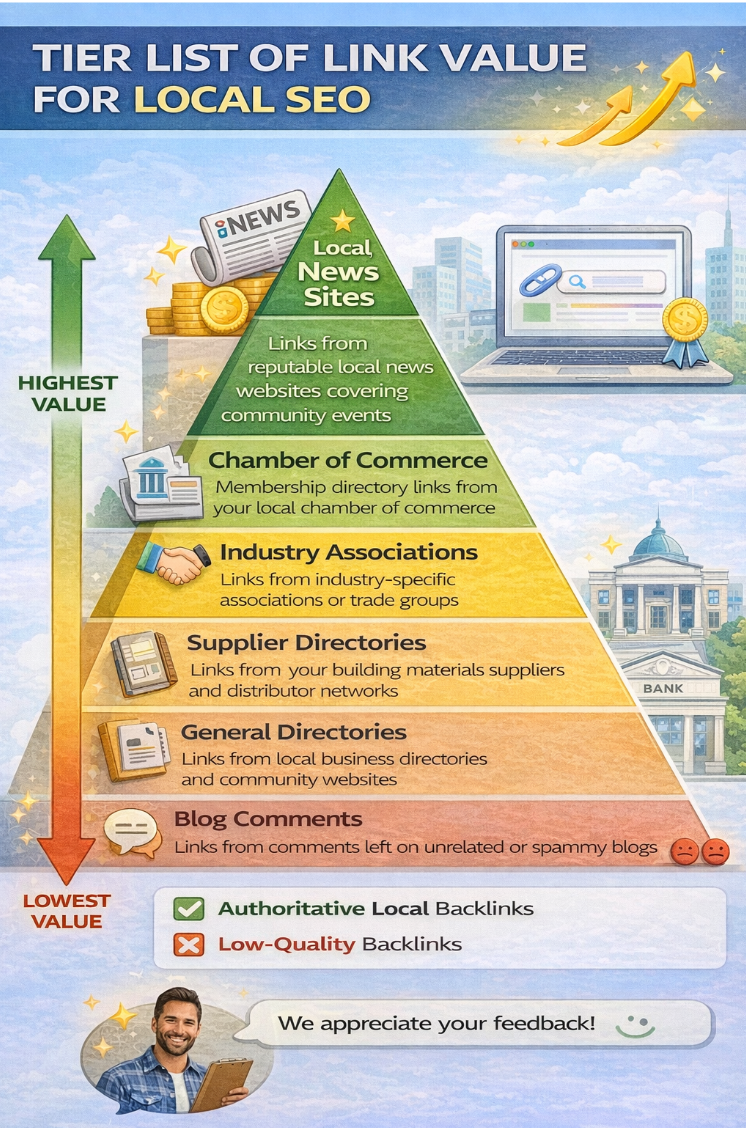
Backlinks—links from other websites pointing to yours—remain one of Google’s strongest ranking signals. For local SEO, links from locally relevant, authoritative sources carry particular weight.
Partner with Local Businesses and Organizations
Building genuine relationships in your community naturally leads to link opportunities. Sponsor local sports teams, school events, or charity fundraisers. These organizations often list sponsors on their websites with links.
Join your local Chamber of Commerce, Better Business Bureau, or trade associations. Most provide member directory listings with links. Participate in community events and offer to speak at local business groups or homeowner association meetings.
Create Linkable Local Content
Content that provides unique local value naturally attracts links. Consider creating: comprehensive guides to local building codes and permits, neighborhood-specific home improvement cost guides, historical preservation guidelines for older homes in your area, or case studies showcasing challenging local projects.
Local news outlets and blogs often link to businesses that provide expert commentary on relevant topics. Reach out to local journalists covering real estate, home improvement, or construction with offers to provide expert insights for their stories.
Leverage Supplier and Manufacturer Relationships
Many building materials suppliers, manufacturers, and distributor networks maintain contractor directories on their websites. If you’re a certified installer for specific products or belong to installer networks, claim those listings.
For example, if you’re a James Hardie siding installer, an Andersen Windows certified contractor, or a GAF roofing professional, these manufacturers may list you on their dealer locator pages with backlinks to your site.
Monitor and Disavow Toxic Links
Not all backlinks help your SEO. Low-quality links from spammy directories, irrelevant sites, or obvious link schemes can harm your rankings. Use Google Search Console’s Links report to monitor your backlink profile regularly.
If you identify harmful links, attempt to have them removed by contacting the site owner. If unsuccessful, use Google’s Disavow Tool to tell Google to ignore those links when evaluating your site.
Step 7: Optimize Your Website Content Strategy
Beyond service and location pages, a content marketing strategy establishes your expertise, attracts organic traffic, and supports your local SEO efforts through internal linking and topical authority.
Create Location-Based Blog Content
Blog posts targeting local topics can rank for long-tail searches and attract potential customers early in their research phase. Write content addressing common questions homeowners in your area ask about projects, permits, costs, and timelines.
Effective local blog topics include: “Average Cost of Kitchen Remodeling in [City],” “How to Navigate [City] Building Permits for Home Additions,” “Best Neighborhoods in [City] for Home Renovations,” or “Top Home Design Trends in [Region].”
These posts establish local relevance, demonstrate expertise, and create opportunities to naturally link to your service and location pages, strengthening their authority.
Showcase Projects with Detailed Case Studies
Transform your portfolio into SEO assets by creating detailed project case studies. Document the challenge, your solution, materials used, timeline, and final results with before-and-after photos.
Include specific location information: “This historic home in downtown [City]’s [Neighborhood] required…” This content ranks for location-specific searches while building trust through transparency about your process and results.
Case studies also provide opportunities to target service + location combinations organically: “Basement Finishing Project in [City]” naturally includes relevant keywords while telling a compelling story.
Answer Common Customer Questions
Create FAQ content that directly addresses questions potential customers ask during the decision-making process. Topics might include: what to expect during a remodel, how to choose between materials, typical project timelines, how to prepare your home, or how estimates work.
This content supports your sales process by educating prospects before they contact you, qualifying leads, and establishing authority. It also captures featured snippets and “People Also Ask” placements in search results.
For guidance on optimizing content elements, explore strategies for building effective contractor landing page structures that convert visitors into leads.
Step 8: Track Performance and Refine Your Strategy
Local SEO is not a one-time project but an ongoing process requiring monitoring, analysis, and optimization. Without tracking results, you can’t identify what’s working or where to focus improvements.
Set Up Essential Tracking Tools
Google Search Console and Google Analytics provide free, powerful insights into your website’s performance. Search Console shows which keywords trigger your pages in search results, your average position, click-through rates, and technical issues affecting visibility.
Google Analytics reveals how visitors find your site, which pages they view, how long they stay, and which sources generate leads. Set up goal tracking for form submissions, phone calls, and other conversion actions to measure ROI.
Your Google Business Profile Insights dashboard shows how many people found your listing through search versus Maps, what actions they took (website visits, direction requests, phone calls), and how your metrics compare to similar businesses.
Monitor Local Rankings by Location
Local rankings vary significantly by search location. Someone searching “general contractor” from one neighborhood may see different results than someone five miles away. Use local rank tracking tools like BrightLocal, LocalFalcon, or SEMrush to monitor your positions across different locations in your service area.
Track rankings for your most important keywords in each target city. Focus on terms that drive actual business: “[service] in [city],” “[service] near me,” “best [service type] [location],” and branded searches for your company name.
Analyze Which Sources Generate Leads
Not all traffic creates equal value. Implement call tracking numbers for different marketing channels to identify which sources generate actual phone inquiries. Use unique forms or tracking parameters for different landing pages to measure lead quality by source.
Review this data monthly to understand: which locations generate the most leads, which services get the most inquiries, which content pages drive conversions, and how organic search compares to other marketing channels.
Conduct Quarterly SEO Audits
Schedule comprehensive reviews every three months to identify opportunities and problems. Check for: new citation opportunities or inconsistencies, competitor analysis (are they outranking you, and why?), content gaps (what topics could you cover?), technical issues affecting crawling or indexing, and link building opportunities you’ve missed.
Use tools like Moz, Ahrefs, or SEMrush to conduct detailed audits, or hire an SEO professional to provide objective analysis and recommendations.
| Metric to Track | Tool to Use | What It Reveals |
| Local Rankings | BrightLocal, LocalFalcon | Position in local pack and organic results by location |
| Organic Traffic | Google Analytics | How many visitors find you through search |
| GBP Performance | Google Business Profile Insights | Views, actions, and comparison to competitors |
| Keyword Performance | Google Search Console | Which search terms trigger your pages and CTR |
| Lead Sources | Call tracking + form analytics | Which marketing channels generate actual inquiries |
| Citation Consistency | Moz Local, BrightLocal | NAP accuracy across directories |
Common Local SEO Mistakes General Contractors Make
Understanding what not to do is as important as knowing best practices. These common mistakes undermine local SEO efforts and waste valuable resources.
Neglecting Google Business Profile Updates
Creating your profile and never touching it again signals to Google that your business may be inactive or irrelevant. Post updates regularly—at least once per week—sharing project photos, company news, seasonal tips, or special offers.
Businesses that post weekly receive 70% more actions (calls, website visits, direction requests) than those that don’t. Google also rewards active profiles with better visibility.
Creating Duplicate or Thin Location Pages
The temptation to quickly create pages for 20 cities by copying the same template and swapping city names is strong, but Google recognizes this tactic as low-value content. Pages with near-duplicate content rarely rank well and may trigger penalties.
Instead, create fewer pages with substantial, unique content. It’s better to have five excellent location pages that rank well than 25 thin pages that don’t rank at all.
Ignoring Negative Reviews
Failing to respond to negative reviews makes you appear uncaring and unprofessional. Even worse, not responding denies you the opportunity to show potential customers how you handle problems.
Respond to every negative review promptly, professionally, and with a genuine offer to resolve the issue. This demonstrates accountability and customer service commitment to everyone reading your reviews.
Using Inconsistent NAP Information
Different phone numbers, addresses, or business names across directories confuse search engines and dilute your local signals. This is especially common when businesses move locations, change phone systems, or rebrand without updating all their listings.
Conduct regular citation audits to catch and correct inconsistencies before they damage your rankings.
Focusing Only on Rankings, Not Conversions
Ranking #1 in local search means nothing if visitors don’t convert into leads. Your website must clearly present your services, showcase your work, display trust signals (licenses, insurance, certifications), and make it easy to contact you with prominent phone numbers and simple forms.
Test different calls-to-action, form placements, and page layouts to optimize conversion rates alongside your ranking improvements.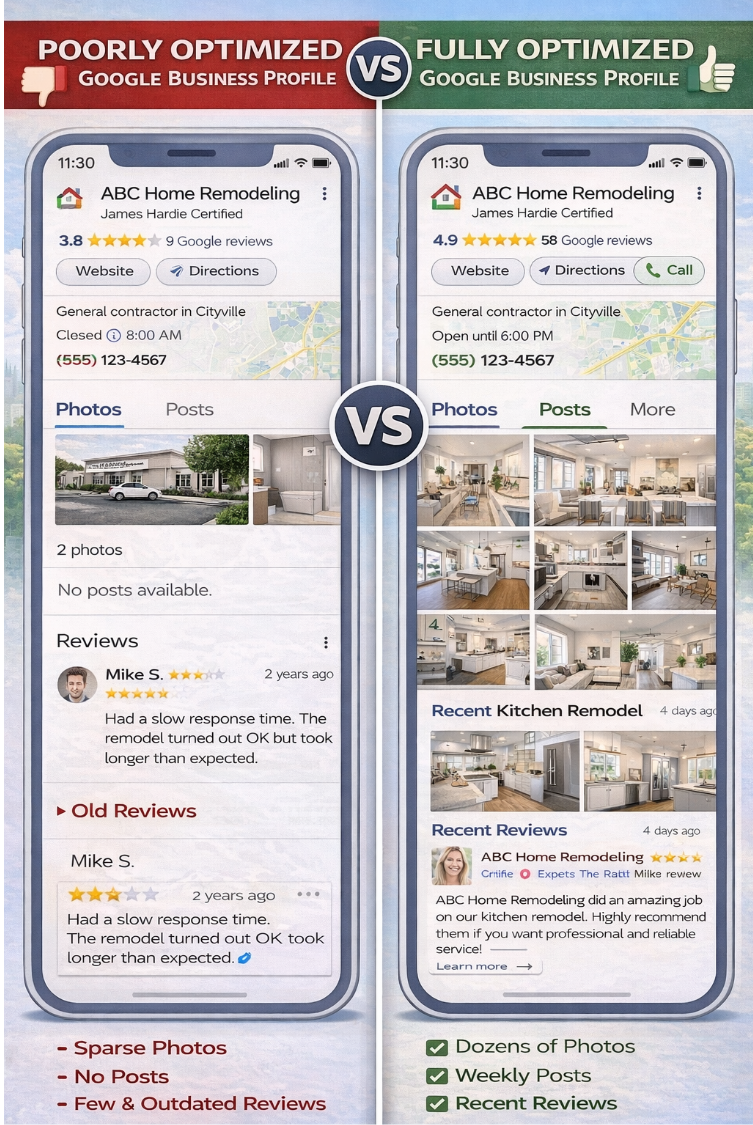
Advanced Local SEO Tactics for Competitive Markets
Once you’ve mastered the fundamentals, these advanced strategies can help you outperform entrenched competitors in saturated markets.
Create Neighborhood-Level Landing Pages
In competitive cities, ranking for broad city-level terms may be difficult. Instead, create highly targeted pages for specific neighborhoods, subdivisions, or zip codes within larger cities.
A page targeting “Kitchen Remodeling in Lincoln Park, Chicago” faces less competition than “Kitchen Remodeling in Chicago” and can attract highly qualified leads from that specific area. These micro-local pages work especially well in large metropolitan areas.
Implement Review Generation at Scale
Consistent review generation requires systems, not occasional requests. Integrate review requests into your project workflow: send automated requests at project milestones (completion, final walkthrough), train crew members to mention reviews during final interactions, and follow up with past customers quarterly.
Consider offering incentives for reviews (within platform guidelines)—not payment for positive reviews, but entry into drawings or small thank-you gifts for any honest review.
Build Location-Based Link Partnerships
Develop strategic partnerships with complementary local businesses that serve the same customers: real estate agents, interior designers, architects, landscapers, or home stagers. Create referral arrangements and link to each other’s websites from resource pages.
Guest post on local blogs, real estate websites, or home improvement publications. Offer expert commentary for local news stories. These activities generate authoritative backlinks while positioning you as a local industry leader.
Leverage Video Content for Local SEO
Video content increasingly appears in local search results. Create project walkthroughs, customer testimonials, how-to videos, and behind-the-scenes content showcasing your work process.
Upload videos to YouTube with location-specific titles, descriptions, and tags. Embed relevant videos on your location pages to increase engagement and time on page—both positive ranking signals.
How Long Does It Take to See Local SEO Results?
Local SEO timelines vary significantly based on competition levels, your starting point, and resource investment. Understanding realistic expectations helps maintain commitment to the strategy.
Initial Changes: 1-3 Months
Google Business Profile optimizations typically show results fastest. After completing and optimizing your profile, you may see increased visibility in Maps results and the local pack within 4-8 weeks.
Technical fixes like improving page speed, fixing broken links, or implementing schema markup can show positive impacts within 30-60 days as Google recrawls and reindexes your improved pages.
Meaningful Improvement: 3-6 Months
New location pages, citation building, and link acquisition generally require 3-6 months to demonstrate measurable ranking improvements. Google needs time to discover new content, verify citation consistency, and evaluate link quality.
During this period, focus on consistent execution rather than constantly checking rankings. Build momentum through regular content creation, review generation, and relationship development.
Competitive Positioning: 6-12 Months
Achieving top positions in competitive markets against established competitors typically requires 6-12 months of sustained effort. The longer competitors have held top positions, the more authority you need to build to displace them.
Markets with fewer contractors or less digital sophistication may show results faster. Metro areas with dozens of optimized competitors require longer investment to break through.
Sustained Dominance: 12+ Months
Once you achieve strong rankings, maintaining and expanding them becomes easier but still requires ongoing effort. Continue generating reviews, creating content, building links, and optimizing your presence to protect against competitors and adapt to algorithm changes.
The contractors who dominate local search long-term treat SEO as a core business function, not a one-time project.
Frequently Asked Questions
How do general contractors set up and optimize a Google Business Profile for maximum local leads?
Start by claiming your business at google.com/business and completing verification. Fill out every profile section completely, including business name, address, phone, website, hours, and categories. Select “General Contractor” as your primary category and add relevant secondary categories like “Remodeling Contractor” or “Kitchen Remodeler.” Write a detailed business description explaining your services, service areas, and what makes you different. Upload at least 20-30 high-quality photos showing your team, completed projects, and work in progress. Post updates weekly with project photos, tips, or company news. Enable and respond to customer messages within 24 hours. Most importantly, actively request and respond to customer reviews, aiming for at least 2-4 new reviews monthly. Set up your services list with descriptions and pricing information where applicable.
What pages should a general contractor website have to rank in multiple service areas?
Your site architecture should include dedicated location pages for each city or region you serve, each with unique content addressing local market conditions, popular neighborhoods, building codes, and completed projects in that area. Create service-specific pages for your main offerings like kitchen remodeling, bathroom renovation, additions, or new construction. Consider building combined service + location pages for your most profitable offerings in key markets, such as “Kitchen Remodeling in [City].” Include an about page establishing credibility through licenses, certifications, and team backgrounds. Add a comprehensive project gallery organized by service type and location. Create a blog for ongoing content addressing common customer questions and local topics. Include clear contact pages with multiple ways to reach you. Ensure every page has proper title tags, meta descriptions, header tags, and internal links connecting related content.
How do reviews, photos, and Google Business Profile posts impact local rankings for contractors?
Reviews directly influence local pack rankings through quantity, quality, recency, and review velocity. Google’s algorithm considers total review count, average rating, how recently you received reviews, and your response rate. Businesses with 40+ reviews typically outrank those with fewer, assuming other factors are equal. Photos increase engagement metrics that Google monitors—profile views, website clicks, direction requests, and phone calls. Profiles with more photos receive significantly more actions than those with minimal images. Google Business Profile posts signal active management and provide fresh content. Regular posting keeps your profile appearing dynamic and relevant, which Google rewards with better visibility. Posts also give you opportunities to include keywords, showcase recent projects, and provide timely information that can appear directly in search results. Combined, these elements create a comprehensive signal to Google that your business is active, reputable, and deserving of prominent placement in local search results.
What are the best link-building and citation strategies for general contractors targeting local cities?
Begin with data aggregators like Infogroup, Neustar Localeze, Factual, and Foursquare to distribute your NAP information broadly. Claim listings on major directories including Google Business Profile, Bing Places, Apple Maps, Yelp, Facebook, and YellowPages. Target contractor-specific directories like Houzz, Porch, BuildZoom, and Angie’s List. Join your local Chamber of Commerce, Better Business Bureau, and industry associations for directory links. Sponsor local events, sports teams, or charitable organizations that list sponsors online. Develop partnerships with complementary businesses like real estate agents, interior designers, or architects who can link to you from resource pages. Create valuable local content like neighborhood guides or permit tutorials that local blogs and news sites want to reference. Leverage supplier relationships—many manufacturers maintain contractor directories for certified installers. Guest post on local business blogs or contribute expert commentary to local news publications. Ensure all citations maintain perfectly consistent NAP information across every platform to maximize their SEO impact.
How can general contractors track local SEO performance and know which keywords, pages, and locations are generating leads?
Implement Google Search Console to monitor which keywords trigger your pages in search results, your average positions, and click-through rates for each query. Use Google Analytics with goal tracking configured for form submissions, button clicks, and page conversions. Set up call tracking with unique phone numbers for different marketing channels or locations to identify which sources generate phone inquiries. Monitor Google Business Profile Insights to see how many people find your listing through search versus Maps, what actions they take, and how you compare to competitors. Use local rank tracking tools like BrightLocal or LocalFalcon to monitor your positions across different geographic points in your service area. Implement UTM parameters on all external links to track traffic sources accurately. Set up conversion tracking in Google Ads if you run paid campaigns alongside organic efforts. Create a simple spreadsheet or CRM system to track lead sources when prospects contact you, asking how they found you. Review these metrics monthly to identify which locations generate the most leads, which service pages convert best, and which keywords drive qualified traffic worth your continued investment.
Final Thoughts: Building Long-Term Local Visibility
Local SEO for general contractors is not a quick fix or a one-time project. It’s a strategic, ongoing commitment to building digital visibility in the communities you serve. The contractors who succeed treat local SEO as a fundamental business practice, not an optional marketing tactic.
Start with the foundations: optimize your Google Business Profile completely, build location pages with genuine local value, ensure your technical SEO is sound, and create systems for consistent review generation. These core elements establish the infrastructure everything else builds upon.
Expand gradually into advanced tactics as your foundation strengthens. Add content marketing, pursue strategic link building, and refine your approach based on performance data. The most successful contractors don’t try to implement everything simultaneously—they execute fundamentals excellently, then layer additional strategies systematically.
Remember that local SEO complements, rather than replaces, other marketing channels. Word-of-mouth referrals, networking, community involvement, and paid advertising all work synergistically with organic search visibility. The goal is creating multiple lead sources that support consistent business growth.
If you’re ready to implement a comprehensive local SEO strategy but need expert guidance, GC Sherpa specializes in helping general contractors dominate their local markets through proven SEO strategies. We understand the unique challenges contractors face and create customized approaches that generate measurable results. Contact us today to schedule a consultation and discover how strategic local SEO can transform your lead generation and business growth.