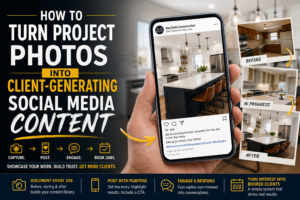

Contractors in New York and the San Francisco Bay Area are sitting on a goldmine of visual content every single day, and most of them don’t realize it. This guide breaks down exactly how to transform ordinary project photos into compelling social media posts that attract new clients, build trust, and keep your pipeline full without a marketing degree or a big budget.
You finished another job. The countertops are gleaming, the deck came out exactly how the client wanted, and you snapped a few quick photos before packing up. Then those photos sit in your camera roll, doing absolutely nothing. Meanwhile, a homeowner two miles away is scrolling Instagram right now, looking for someone to trust with their kitchen remodel. That disconnect is costing you real business, and it’s completely fixable.
Key Takeaways
- Project photos are your most credible form of marketing because they show real work, not stock imagery or promises.
- A consistent posting strategy tied to before-and-after content dramatically increases profile engagement and inbound inquiries.
- Captions matter as much as the image itself. A good caption tells a story, answers objections, and prompts action.
- Platform selection should match where your ideal clients actually spend their time, not where it’s easiest to post.
- Even one quality post per week, done consistently, outperforms sporadic bursts of content.
- Local geo-tagging and location-specific language help you surface in search results for your exact service area.
Why Are Most Contractor Social Media Profiles Not Generating Leads?
The problem isn’t that contractors don’t have content. It’s that the content they post doesn’t do any work. A photo of a finished bathroom without context is just a pretty picture. There’s no story, no call to action, no reason for a potential client to stop scrolling and reach out. The image exists, but it isn’t selling anything.
Most contractor profiles fall into one of two traps. Either they post rarely and inconsistently, which signals to the algorithm and to visitors that the business isn’t active, or they post too casually without thinking about what a prospective client actually needs to see before picking up the phone. Both patterns leave real money on the table.
Studies in social media marketing consistently show that visual content generates significantly more engagement than text-only posts, with some platforms reporting that image-based posts receive up to three times more interaction. For service businesses where trust is the primary buying factor, that visual credibility translates directly into inquiries and booked jobs.
What Makes a Project Photo Actually Generate Clients?
Not every photo of your work has equal pull. A well-lit, clearly composed image of a finished project will always outperform a blurry snapshot taken in a rush. That said, technical perfection isn’t the goal. Authenticity paired with intentionality is what converts a viewer into a caller.
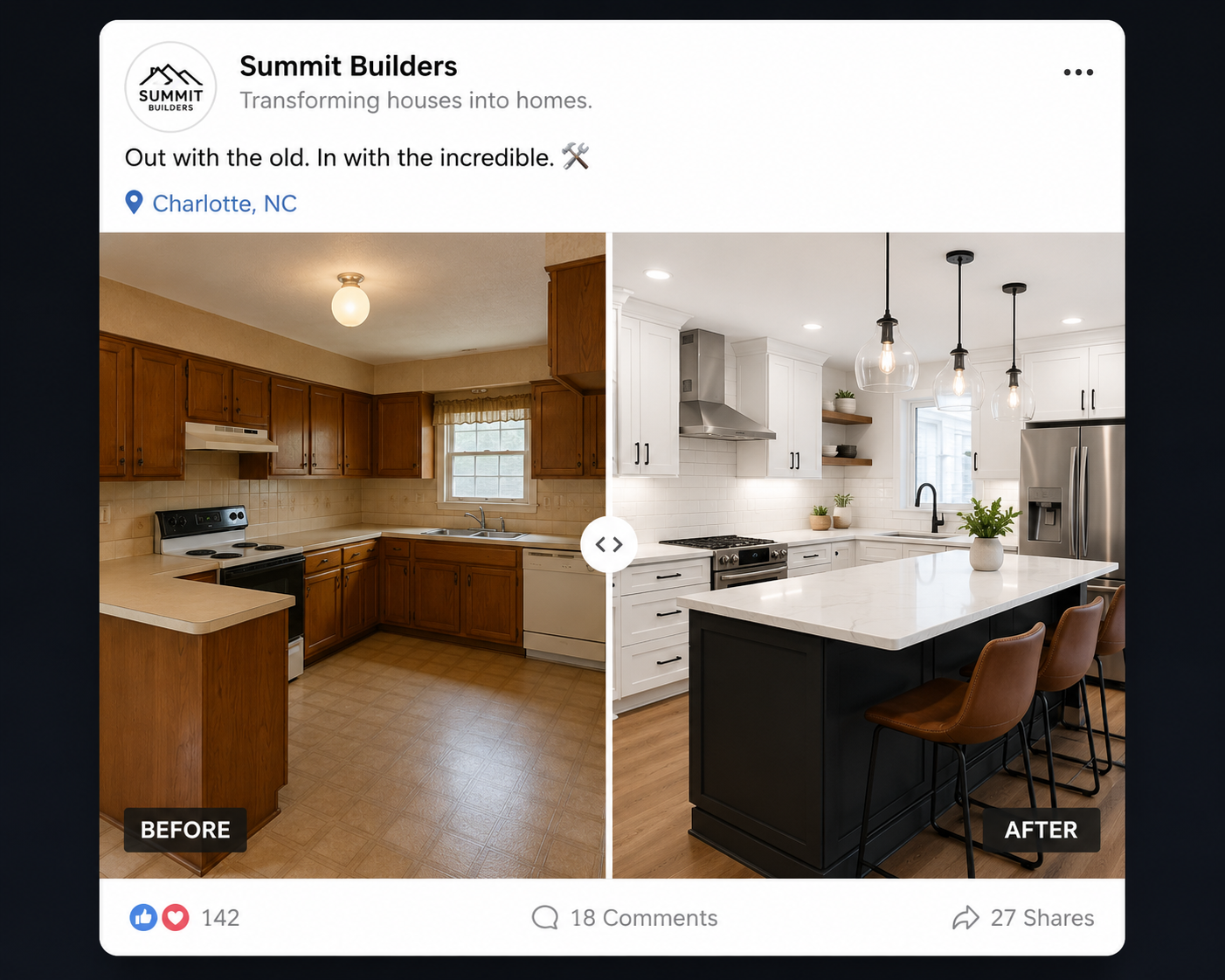
The single most powerful format in construction and home improvement marketing is the before-and-after post. Showing the starting point alongside the finished result does something that a solo “finished product” photo never can: it makes the transformation tangible. The viewer mentally places their own problem-space into that before image and starts imagining their own after. That’s the moment desire gets activated.
Before-and-after content in the home services vertical consistently ranks among the top-performing post formats across Instagram and Facebook, with engagement rates often running 40 to 60 percent higher than single-image posts showing only the finished result. This pattern holds particularly strong in high-value renovation categories like kitchens, bathrooms, and exterior work.
The caption is where most contractors drop the ball completely. A caption that says “New deck install. DM for a quote” is doing almost nothing. A caption that says “This homeowner in Westchester had been avoiding their backyard for two summers because the old deck was rotting and unsafe. We completed this full rebuild in four days and now they’re hosting out there every weekend” is doing everything. It names the problem, shows the solution, gives a timeline, and ends with an emotional payoff.
Which Platforms Should Contractors Focus On?
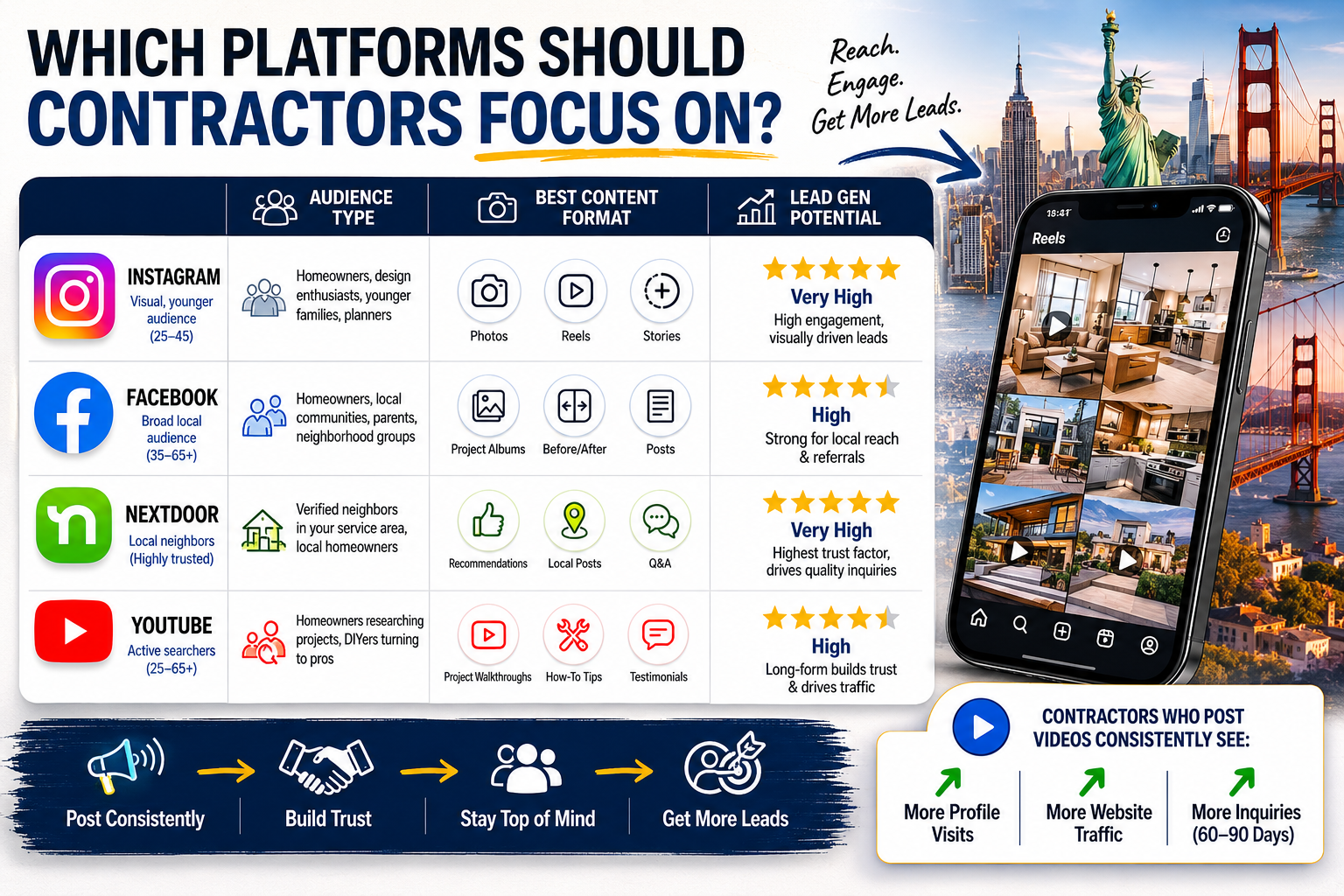
The honest answer depends on your market and your client profile, but for most residential contractors working in New York and the San Francisco Bay Area, Instagram and Facebook remain the highest-return platforms for visual project content. Instagram skews younger and favors polished imagery, while Facebook still holds strong for local homeowner communities and neighborhood groups where referrals happen organically.
Nextdoor deserves a mention that most contractors overlook. In dense suburban markets around New York and across Bay Area neighborhoods, Nextdoor recommendations carry enormous weight because they come from verified neighbors. A single well-received post or a recommendation from a satisfied client there can drive a week’s worth of inquiries.
YouTube and short-form video platforms like TikTok and Instagram Reels are growing rapidly as discovery tools for home improvement services, with data suggesting that contractors who post even basic walkthrough videos of completed projects see a measurable uptick in profile visits and website traffic within 60 to 90 days of starting a consistent video posting schedule.
How Do You Build a Repeatable Content System From Your Job Site?
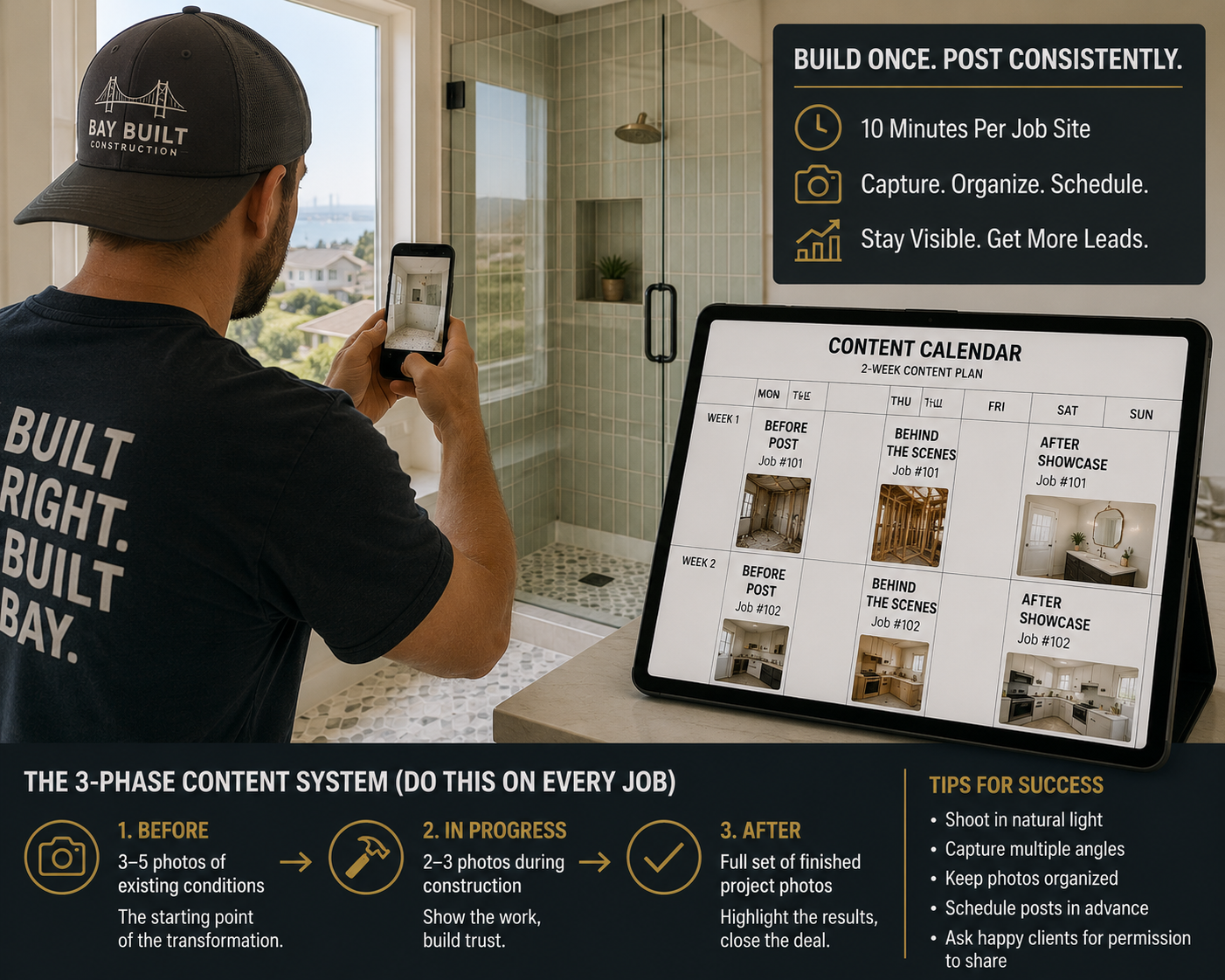
The biggest obstacle isn’t creativity. It’s consistency. Most contractors will put effort into social media for a week or two after a great job, then go quiet for a month because work gets busy. A simple system that takes ten minutes per job site visit is far more valuable than an elaborate strategy you can never actually execute.
Here’s the framework that works. At the start of every job, take three to five photos of the existing conditions. At mid-project, grab two to three shots of the work in progress. At completion, take a full set from multiple angles in good natural light. That’s your content library for that job. One before-and-after post, one in-progress “behind the scenes” post, and one finished-project showcase post, scheduled over two weeks.
When you batch this process across even two or three active jobs at a time, you’ll have more content than most contractors post in a quarter. The key word is system. Don’t rely on inspiration. Rely on the habit of documenting, because every job site you walk into is a content opportunity.
What Role Do Captions, Hashtags, and Geo-Tags Play?
Think of your caption as a short story with a specific job to do. It should open with the client’s situation or the challenge the project solved, move through what your team did, and close with a clear signal of what viewers should do next if they want the same result. You don’t need to write a novel. Three to five focused sentences will outperform a wall of text every time.
Hashtags still carry relevance on Instagram, especially when they’re specific. Broad tags like #construction or #remodeling are so saturated they offer little discoverability. Location-specific tags like #WestchesterContractor, #BayAreaRenovation, or #SFHomesImprovement give your post a fighting chance of being found by someone actively searching in your service area. Use a mix of five to ten tags rather than stuffing thirty generic ones.
Geo-tagging your posts to the neighborhood or city where the job was completed is one of the most underused tactics in local contractor marketing. When someone searches Instagram for posts tagged in their neighborhood, your finished project in their community becomes a form of hyperlocal proof. It says, without saying it outright, “we already work here and people trust us.”
Location-tagged posts on Instagram have been reported to receive substantially higher engagement than posts without geotags, with some marketing studies indicating increases of 70 to 80 percent in overall post reach. For local service businesses, this visibility lift is particularly meaningful because the audience seeing those posts is geographically concentrated in the exact areas where the business can realistically take on work.
How Can You Turn Engagement Into Actual Booked Jobs?
Likes and comments are nice. Booked appointments pay the bills. The gap between social media activity and revenue comes down to how clearly you guide interested viewers toward taking action. Every post that showcases finished work should have a next step baked in. Not a generic “contact us,” but something specific that reduces friction.
Phrases like “We’re booking kitchen remodels for this fall in Westchester and Hudson Valley, comment below or DM us to check your dates” work because they create mild urgency, include a location signal, and give someone a concrete action. Pair that with a saved Instagram Story highlight labeled “Recent Projects” and a link to your contact page in your bio, and you’ve built a simple but functional funnel from scroll to inquiry.
Following up on comments promptly is another conversion multiplier most contractors ignore. When someone comments “this is beautiful, how much does something like this cost?” responding within a few hours with a brief, friendly answer and an invitation to connect privately signals professionalism and responsiveness before you’ve ever spoken to them. That first impression shapes the entire relationship.
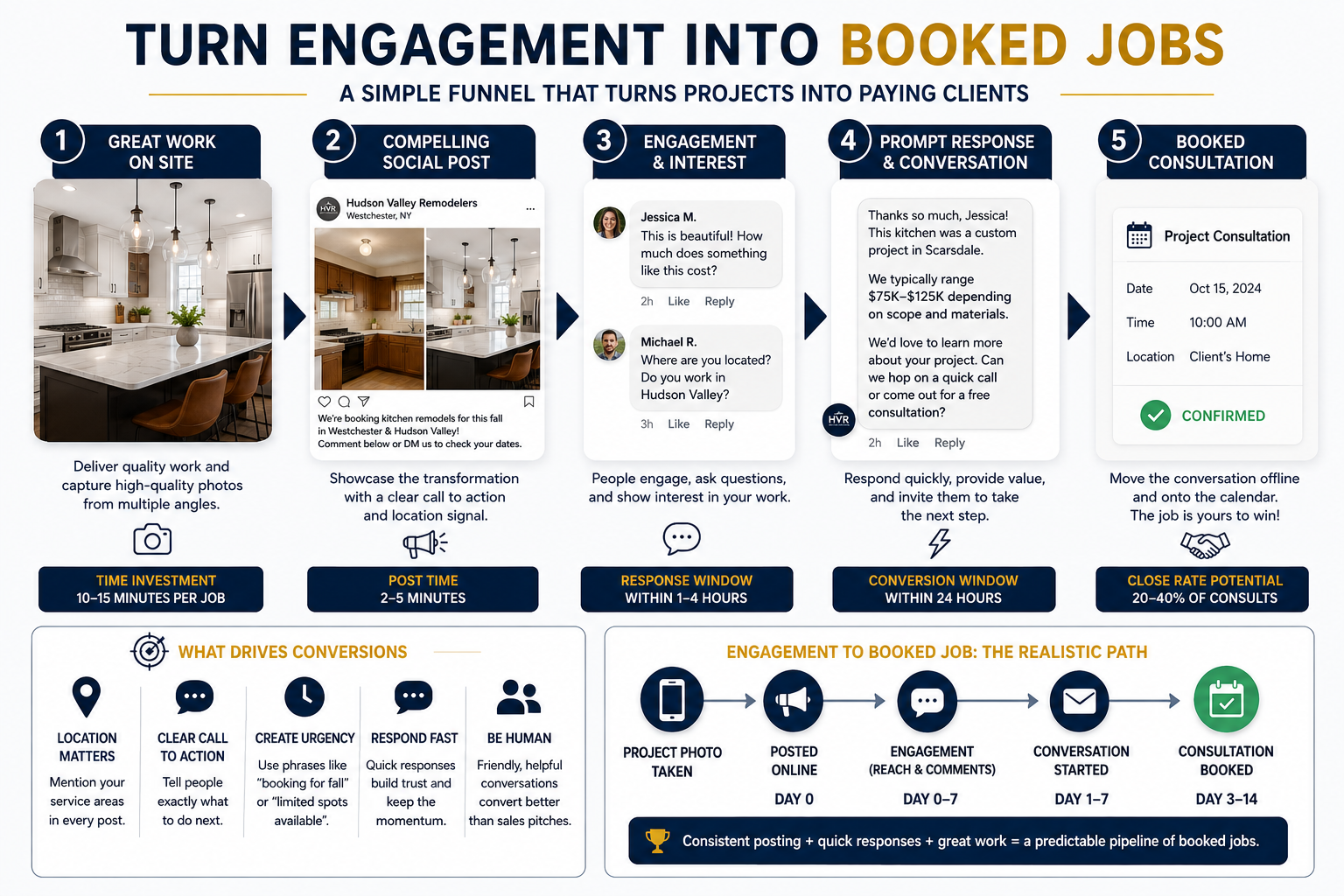
Response time to social media inquiries has a measurable impact on conversion rates. Research in digital marketing for service businesses indicates that responding to a lead within one hour makes a business seven times more likely to qualify that lead versus waiting just one additional hour. For contractors competing in high-demand markets like New York City suburbs and the Bay Area, this speed advantage can directly determine who wins the job.
Frequently Asked Questions
What is client-generating social media content for construction businesses?
Client-generating social media content refers to posts, images, videos, and captions specifically crafted to attract potential customers and move them toward booking a service. For construction businesses, this typically means showcasing completed work in a way that builds credibility, demonstrates expertise, and prompts viewers to reach out. The goal isn’t just visibility; it’s converting that visibility into actual paying clients.
How does posting project photos help attract new clients?
Project photos serve as visual proof of your workmanship in a way that no written description can match. When a homeowner sees a finished kitchen or deck that looks like what they want for their own home, the decision-making process starts immediately. Pairing strong images with location context and a clear call to action gives interested viewers a direct path from “I love this” to “I want to call them.”
What are the main benefits of turning project photos into social media content?
The benefits span several dimensions. From a marketing standpoint, consistent visual content builds brand recognition and keeps your business top of mind in your local area. From a credibility standpoint, real project photos outperform any ad copy because they show actual results. From a business development standpoint, a well-maintained social profile reduces your dependence on paid advertising and word-of-mouth alone by creating a consistent inbound channel you control.
Who should use project-photo marketing strategies for social media?
Any contractor, remodeler, or home improvement professional who relies on local clients should be using this approach. It’s especially valuable for businesses in competitive markets like New York and the San Francisco Bay Area, where homeowners have many options and look for trust signals before making a call. If you do work you’re proud of, you already have the raw material. The strategy is just about packaging it effectively.
When is the best time to post project photos for maximum engagement?
On most platforms, evenings on weekdays and mid-morning on weekends tend to perform well for home improvement content, because that’s when homeowners are relaxed and browsing rather than commuting or working. That said, the most important variable isn’t the exact hour; it’s consistency. Posting at a slightly suboptimal time every week beats posting at the perfect time once a month. Test a few time slots over 60 days and let your own audience data guide you from there.
Ready to Turn Your Best Work Into Your Best Marketing?
Every finished project you walk away from is a marketing asset. The question is whether it stays locked in your camera roll or gets put to work attracting the next client. For contractors in New York and the San Francisco Bay Area, where competition is real and homeowners are selective, a consistent social media presence built on authentic project content isn’t optional anymore. It’s one of the clearest paths to a full pipeline.
Imagine having a social profile that does quiet, steady selling for you 24 hours a day, while you focus on the work itself. That’s not a fantasy; it’s what happens when you build a simple, repeatable content system around the jobs you’re already completing. The work is already happening. The documentation just needs to happen alongside it.
If you’re not sure where to start, or you’ve tried posting before and never felt like it moved the needle, the team at GC Sherpa specializes in helping contractors build exactly this kind of client-generating content strategy. Whether you’re working out of New York or the Bay Area, the approach is practical, specific to your trade, and designed to produce real inquiries, not just likes. Give the team a call at (845) 533-3309 and have a straightforward conversation about what consistent, strategic social media content could mean for your business this season.