

General contractors have long relied on word-of-mouth to win new projects. In the digital age, social media has become the new word-of-mouth, offering a powerful way to showcase your work and build trust with potential clients – all without spending a dime on advertising.
In fact, a recent industry survey found that while only about 53% of contractors use social media, a full 71% of homeowners seek recommendations on social platforms when looking for contractors.
This means many contractors are missing out on where their customers are researching. Leveraging organic (non-paid) social media strategies can help you bridge that gap by expanding your visibility, demonstrating your expertise, and engaging your community.
In this guide, we’ll explore how general contractors of all sizes and specialties can effectively use social media to get clients – without paid ads. We’ll cover choosing and optimizing the right platforms, building community engagement, creating content that attracts leads, and tracking performance to continually improve.
The Value of Organic Social Media for Contractors
Using social media organically (i.e. without paid promotions) can deliver significant benefits for contractors. It’s essentially a low-cost marketing channel that provides direct access to your target audience. Research shows that social media use can reduce marketing costs while improving customer relationships, thanks to the two-way communication it enables.
Social media also greatly extends your reach. Most consumers now use social media as a standard part of their research before choosing a service provider. In one 2024 survey, 67% of U.S. social media users said they check social platforms to research products or services before making purchase decisions.
For local services like construction, many people turn to Facebook or community groups to ask for contractor recommendations, or browse Instagram for design ideas and then note the builders behind them. If your company has an active and credible presence, you become part of that consideration set. Even if a prospect hears about your firm offline, they are likely to look you up on social media for reviews and to vet your experience before contacting you.
Crucially, this visibility comes with virtually no direct cost aside from your time and effort. This is a big advantage for contractors who often operate with limited marketing budgets. You don’t have to outspend bigger competitors on ads – by investing consistent effort into organic social media marketing, you can punch above your weight. It’s no wonder that around 90% of small/local businesses now include social media in their marketing strategy. For general contractors, a strong social media presence can enhance your word-of-mouth referrals, bolster your professional reputation, and keep your pipeline of leads flowing – all without paying for advertising.
Optimizing Your Social Media Presence (Platforms and Profiles)
Choosing the right platform and optimizing your profile is the foundation of organic social media success. Rather than trying to be everywhere, identify which social networks your potential clients frequent and focus your efforts there.
For example, residential general contractors who serve homeowners may find Facebook and Instagram most valuable, given their broad consumer user base, whereas commercial contractors or B2B firms might prioritize LinkedIn for reaching developers, architects, and other businesses.
A national study by Pew Research shows that Facebook is used by 68% of American adults (including a large share of the 30–64 age group that many homeowners fall into), while Instagram is used by about 47% of adults, skewing heavily toward ages 18–29. LinkedIn is used by roughly a third of adults (particularly professionals 30–49) and is regarded as the top social platform for B2B marketing value. In short, meet your customers where they already are.
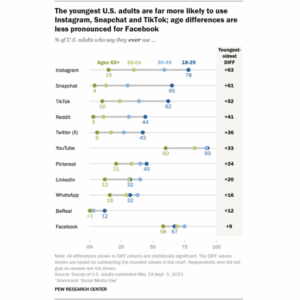
Data from Pew Research Center show that younger adults dominate platforms like Instagram, Snapchat, and TikTok, whereas Facebook and YouTube have broader usage across all age groups. General contractors should consider the demographics of their target clients when choosing social platforms – for instance, a home remodeler targeting young families might emphasize Instagram, while a commercial builder would lean into LinkedIn.
Once you’ve selected the platform(s) that best match your audience, optimize your profile/page to make a strong first impression. Use a recognizable profile image (your company logo or a photo of a signature project) and fill out all contact details. A complete profile with your services, location, website link, and a short bio that highlights your expertise and experience will instill confidence in visitors.
This is important because people don’t typically hire a contractor directly from a social media page, but they will use it to judge your credibility. Ensure your branding is consistent across platforms (same logo, similar tone of voice) to reinforce a professional image – as the saying goes, “multiple touch points, consistent message is critical”.
Next, develop a basic platform strategy. Different social networks have different strengths, and your content should play to those. For example, Facebook business pages excel at community building and can incorporate various content types; Instagram is ideal for visual storytelling of projects; LinkedIn is geared toward thought leadership and networking.
The Associated General Contractors (AGC) of America recommend using Facebook for company culture and community-oriented posts, LinkedIn to showcase industry expertise, Twitter as a quick news or project update feed, and Instagram for visual portfolio highlights. In practice, that means you might post photos of finished projects or team volunteer work on Facebook, publish an article on construction trends or a project case study on LinkedIn, share milestones or press mentions on Twitter, and post striking before-and-after project photos or short video tours on Instagram.
No matter the platform, focus on quality over quantity. It’s better to have one or two well-maintained profiles with valuable content than to spread yourself thin across every network. The AGC guide advises contractors that there’s no need to be on a dozen apps – initially focus on one or two platforms and concentrate on quality posts rather than sheer quantity, and above all be consistent.
An inactive or half-baked profile can undermine trust, so only take on what you can handle consistently. Aim to post regularly (e.g. a few times per week or at minimum a few times per month on each platform), so that anyone who checks your page sees it’s active. Consistency is key to success on any social platform. Use scheduling tools or a content calendar to plan posts in advance if needed. Over time, as you master one platform and if you have the resources, you can expand to others – but always keep your messaging and brand voice unified across them.
Finally, optimize for discoverability. On each platform, take advantage of features that can increase your organic reach: for example, use relevant hashtags (e.g. #homeimprovement, #kitchenremodel) on Instagram, tag project locations or partner companies on Facebook, and participate in industry-specific groups or discussions on LinkedIn. Encourage satisfied clients to leave reviews or recommendations on your Facebook page or to tag your business in their own posts – positive social proof will bolster your credibility for everyone who sees your profile. By strategically choosing platforms and fully optimizing your presence, you set a strong foundation for attracting clients organically.
To summarize platform selection, here’s a quick reference table on the major social networks and how a general contractor might use them:
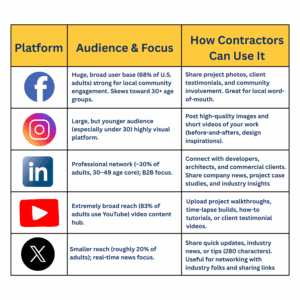
Note: Newer platforms (TikTok, Pinterest, Nextdoor, etc.) can also be valuable in niche ways – e.g. TikTok for creative build videos or Nextdoor for neighborhood-level visibility – but the key is to commit where you can deliver useful content consistently.
Building Community Engagement and Trust
Setting up profiles and posting content is only half the battle – the real power of social media lies in community engagement. Unlike traditional ads, social media lets you actively converse and build relationships with potential clients. For general contractors, engaging with your online community can dramatically amplify trust and word-of-mouth referrals. Remember, people are more likely to hire someone they feel they know and like, even if that familiarity comes from online interactions.
Start by responding promptly to comments and inquiries. If someone asks a question on your Facebook post (“What’s the typical cost of a deck like this?”) or leaves a comment admiring your work, take the time to reply. A quick, helpful response not only might convert that individual into a lead, but it also signals to other viewers that you are responsive and care about your customers. (In fact, responsiveness is critical – studies in sales have shown that the business that replies first to a customer inquiry is far more likely to win the deal.)
Even a simple “Thank you, we loved how this project turned out too!” on a compliment goes a long way in humanizing your company. These two-way interactions foster goodwill; research in marketing has found that social media conversations help build authentic relationships and loyalty between businesses and consumers.
Next, look for opportunities to participate in community discussions relevant to your services. Facebook and LinkedIn both have many groups dedicated to local communities or to construction/home improvement topics. By joining local homeowner groups, neighborhood forums (even apps like Nextdoor), or industry discussion groups, you can share your knowledge and become the go-to expert.
Don’t underestimate the power of social proof and referrals via social media. We know that 71% of homeowners trust and use recommendations on social networks to find contractors. Encourage your satisfied clients to talk about your work online: ask if they wouldn’t mind sharing a photo of their finished remodel on their own social profile and tagging your business, or write a recommendation on LinkedIn if they’re a B2B client.
A single glowing review or project post by a homeowner can lead to multiple inquiries from that person’s friends and followers. You can even create a simple incentive or referral program – for instance, a small gift card for any client who refers a new customer via Facebook. The goal is to turn your clients and followers into a word-of-mouth engine on social media. This is organic marketing gold, because people tend to trust personal recommendations more than any advertisement.
Creating Content That Attracts Leads
- Project Showcase Posts (Portfolio Photos and Videos): Visually highlighting your past work is perhaps the most powerful content type for contractors. Homeowners or developers want to see what you’re capable of. Share photos of completed projects – the before-and-after transformation shots are especially eye-catching – as well as progress photos that tell a story over time. Short videos or slideshows can work well to show different angles or walk through a finished space.According to a study on contractors’ social media usage, 100% of firms surveyed shared image-based posts and over 56% shared videos as part of their content mix, indicating how ubiquitous and essential visual project content is in this industry. These posts serve as a living portfolio.
When posting, add context: mention the location or type of project (e.g., “Kitchen Remodel in Springfield – from outdated oak cabinets to a modern chef’s kitchen”), and note any special challenges overcome or features added. This not only advertises your skills but also educates the viewer on what’s possible (planting ideas for their own project). Project showcases that include clients (with permission) – such as the homeowner standing happily in their new addition – double as testimonials and are excellent for building trust.
- Educational and Informative Content: Not every post should be a sales pitch for your services. In fact, a great way to draw in followers (who can become future clients) is by sharing useful knowledge. Leverage your expertise by posting tips, how-tos, and insights related to construction and home improvement. For instance, a general contractor might post seasonal maintenance tips (“5 Fall Home Maintenance Tasks to Prevent Winter Damage”), quick DIY tips for minor fixes, or a short explainer on how to choose a reliable contractor.Such content provides value to your audience and positions you as a helpful expert. In that Zambian contractors study, about 66% of contractors’ social posts were categorized as informative content (e.g., advice or educational), highlighting the importance of knowledge-sharing in marketing. You might also share links to informative blog articles on your website (if you have one), or even do a short “Q&A video” answering common client questions. Over time, followers will learn to trust your expertise – when they need a pro, you’ll be top of mind thanks to the value you’ve already given them.
- Engaging Storytelling (Case Studies and Behind-the-Scenes): Story-based content helps people connect with your work on a deeper level. Instead of simply posting a photo, you could tell the story of a project: what problem did the client face, how did you solve it, and what was the end result? For example, share a narrative of how you transformed a cramped basement into a livable space for a growing family, with a couple of progress photos and a final reveal.This format is essentially a mini case study and is excellent for Facebook or LinkedIn where you can write a longer caption. Likewise, “day in the life” or behind-the-scenes posts also draw interest – show your team in action at a job site, prepping materials in the morning, or a time-lapse of a day’s progress. It pulls back the curtain on your process and workmanship. These narratives and glimpses behind the scenes make your company more relatable and transparent, which builds trust (E-E-A-T: demonstrating Experience by showing the process). They also tend to prompt comments (“Wow, never knew how much goes into framing a roof!”) which boosts engagement algorithms.
- Client Testimonials and Reviews: Social proof is a powerful motivator. Whenever you receive positive feedback from a client, consider turning it into a piece of content. This could be as simple as posting a quote from a client’s review (with their permission) on a nice background image or alongside a photo of the project. Even better, short video testimonials of clients standing in their renovated space and speaking to their satisfaction can be incredibly persuasive to future clients.Statistics show people trust peer recommendations; showcasing real clients’ happiness can nudge prospects off the fence. For instance, if a client mentions that your timely communication eased their worries, that could speak directly to another homeowner’s chief concern. These testimonials, when posted on your Facebook or LinkedIn, also allow the client to tag/share the post, spreading it to their network and garnering you more exposure through genuine voices.
- Interactive Content and Community Highlights: To further boost organic reach, create posts that invite engagement. Simple ideas include running a poll (e.g., “Which kitchen style do you prefer: A or B? Vote in the comments!” with photos), hosting a live Q&A or a Facebook Live/Instagram Live tour of a project, or starting a weekly series (like “Toolbox Tuesday Tips”).These kinds of posts can spark conversations and shares, which the social algorithms love. Also consider highlighting others in your community or industry – for example, giving a shoutout to a local supplier or another small business you partner with, or congratulating a client on their newly completed home addition. When you tag others, they are likely to engage with and share the post as well, expanding your reach. It creates a network effect where your content is seen by friends-of-friends.
When planning content, variety is important, but it should all reinforce your brand and expertise. A good rule of thumb some marketers use is the 80/20 rule: 80% of your content should inform, educate, or entertain (providing value), and 20% can be more directly promotional (showcasing your services or inviting people to contact you). If you consistently put out valuable and interesting content, you’ll attract followers who trust you – and when they have a project, you’ll be the one they reach out to. Indeed, many small businesses report that social media has significantly boosted their visibility and web traffic.
Some key performance indicators (KPIs) for organic social media marketing include:
- Follower growth: The increase in followers or page likes over time. This shows the expansion of your audience. A steadily growing follower count means your content and brand are attracting interest (though beware of vanity – 100 highly engaged local followers are more valuable than 1,000 inactive or distant ones).
- Engagement metrics: Likes, comments, shares, retweets, saves – any action people take on your content. These indicate how well your content resonates. For example, if one of your project photo posts gets shared 20 times, that’s a sign this content hit a pain point or interest (perhaps the style was inspiring), and it also means it’s being seen by networks beyond your own followers (free advertising!). High engagement rates often correlate with greater trust and interest in your business. Track which types of posts get the most engagement and use that to inform future content (e.g., “our kitchen remodel tips get a lot of comments, let’s do more of those”).
- Click-throughs and website traffic: If you’re sharing links (say, to your website’s portfolio or a contact form), monitor how many people click those links. Tools like Google Analytics can show you how many visitors are coming from social media and what they do on your site. For contractors, a common funnel might be: person finds you on social -> clicks to your website -> fills out a contact form or looks up your phone number. So those click metrics are important for measuring lead generation. You can also use unique tracking links or landing pages for social campaigns to better attribute leads. For example, a “Get a Quote” link that you only ever post on social media, so any leads through it are clearly from that channel.
- Leads and conversion metrics: Keep a simple tally of inquiries that come via social. This could be direct messages you receive on Facebook/Instagram from interested prospects, comments like “Can someone contact me about this?”, or referrals where the client says “I found you on Facebook.” You might even incorporate a “How did you hear about us?” question in your intake. Over a quarter or year, count how many leads and signed projects traced back to social media. If that number is rising, your social strategy is doing its job. If it’s zero, then no matter how many likes you get, you need to adjust strategy to generate inquiries (for instance, by including clearer calls-to-action or showcasing more compelling projects).
- Reach and impressions: These metrics (available in platform analytics) show how many people saw your posts. They give a sense of your visibility. If your follower count is modest, but a post’s reach is 5x your followers because it was shared widely, that’s a win for brand exposure. Aim to increase average reach over time – that likely means growing followers and creating shareable content.
Also, consider A/B testing on a small scale: for instance, post two different styles of project photo (one with people in it, one with just the work) and see which gets more engagement. Over time you’ll develop a data-informed sense of what your audience cares about.
Another advanced tip is to track your competitors’ social media. How many followers do other reputable contractors in your area have? What kind of posts do they get engagement on? This competitive benchmark can provide context for your performance. If you notice a competitor’s videos always do well, maybe video is an area you should explore. There are tools that allow you to compare social media metrics across companies, or you can do it manually by observing their pages. The idea isn’t to copy, but to learn and keep pace with industry standards. As noted earlier, monitoring the competition’s social activity was found to be a relevant and even “mandatory” aspect of a robust marketing framework in research on small contractors.
Finally, don’t forget ROI. While it’s tricky to calculate a precise return on investment for organic social media, you can estimate it by valuing the leads it brings. For example, if in the past quarter you got 5 jobs that you can attribute to social media (either directly or via referrals that started on social) and those jobs brought in $50,000 revenue, that’s $50k of business generated essentially for free – aside from your time spent on social media management.
Tracking this over the long term will help you affirm that your efforts are paying off. If the ROI is low, then it may signal to tweak your strategy or, if you haven’t already, possibly supplement with a small budget for targeted ads or other channels. But many contractors find that a well-run organic social presence yields a strong ROI in the form of quality leads, especially since younger homeowners and even commercial clients are increasingly social-media savvy.
Conclusion
FAQs (Frequently Asked Questions)
Q: Which social media platform is best for getting contracting clients?
A: It depends on your target clientele. For most general contractors, Facebook is extremely useful due to its broad user base and community focus – 68% of U.S. adults use Facebook, and many locals rely on Facebook recommendations for contractors. Instagram is great for visually showcasing remodeling or construction projects, especially if you target a slightly younger, design-conscious crowd (it’s popular among 20- and 30-somethings).LinkedIn is the top platform for B2B networking – if you do commercial contracting or build partnerships with developers and architects, a strong LinkedIn presence is key. (In fact, 85% of B2B marketers say LinkedIn delivers the best marketing results for them.) Y
YouTube can also be valuable for hosting project videos and how-tos. In short: Facebook for local homeowner engagement, Instagram for visual appeal, LinkedIn for professional connections, and YouTube for deeper project storytelling. You don’t need all of them at once – choose based on where your clients are and where you can consistently deliver content.
Q: How often should a general contractor post on social media?
A: Consistency matters more than an arbitrary frequency. It’s advisable to post at least a few times per week on your primary platform so that your page stays active and visible. However, quality trumps quantity – you don’t want to spam low-value posts daily. The AGC recommends focusing on quality over quantity and letting your audience’s appetite guide frequency. Pay attention to engagement: if you post three times a week and get good interaction, that’s a good baseline. If you can increase to daily while maintaining quality (and you have the content ideas to support that), great – just ensure you can keep up that pace.On the flip side, avoid long gaps with no posts; an inactive page can make prospects wonder if you’re still in business. A good practice is to create a content calendar – plan out a month of posts in advance (project highlights, tips, etc.) – this helps maintain regular output. In summary, post as often as you can consistently provide valuable, on-brand content. For many small contractors, 2–4 posts per week on a primary platform like Facebook or Instagram is a manageable and effective rhythm.
Q: We get most of our jobs from referrals. Do we really need social media?
A: Yes, at least a basic presence. Think of social media as an extension of word-of-mouth referrals. Even if most of your leads come from personal recommendations (which is wonderful), those people who hear about you are very likely to look you up online for credibility.If they find an active Facebook page with project photos and positive reviews, it reinforces the referral’s trust (“this company is professional and does great work”). If they find nothing, or a long-abandoned page, it can raise doubts. In essence, social media pages today often serve as your digital brochure and reputation portfolio.
Q: What type of content should I post to attract new clients?
A: The best content for attracting clients is that which demonstrates your expertise, your quality of work, and the value you offer – in an engaging way. Some top-performing content types for contractors include:
- Photos and videos of your projects: Show before-and-after transformations, highlight unique features, or do quick video walkthroughs. Visual proof of your craftsmanship is compelling. (Nearly all contractors on social media use project photos; over half are now using video too because it engages people effectively.)
- Customer testimonials and success stories: Share quotes or short stories from happy clients, with context about the project. This combines proof of quality with a narrative that potential clients can relate to.
- Tips and educational snippets: Position yourself as a helpful expert. For example, a short post on “3 things to check before hiring a contractor” or a diagram explaining the remodeling process. This kind of content builds trust – you’re giving advice freely, which shows confidence and integrity.
- Behind-the-scenes and team spotlights: These humanize your business. Show your team working safely on site, or profile one of your carpenters and their skills. People considering hiring you will feel more connected and trusting if they “know” the people involved.
- Community and industry involvement: If you attend a home show, take part in a charity build, or even just celebrate a company milestone (10 years in business, etc.), share it. This illustrates stability, reliability, and goodwill – attractive qualities in a contractor.