

Contractor landing pages fail not because of bad services, but because of weak design decisions that erode trust before a visitor ever picks up the phone. This post breaks down the specific elements that separate high-converting contractor pages from ones that quietly bleed leads every single day, with actionable guidance for any contractor ready to fix the problem.
Most contractors spend years building a reputation on job sites, then watch that reputation go nowhere online. A visitor lands on their page, spends fifteen seconds skimming it, and leaves without ever calling. The work is good. The pricing is competitive. But the page itself never had a chance of converting them. That disconnect is exactly what this guide is here to fix.
Key Takeaways
- A slow or confusing landing page will lose leads even if your services are excellent.
- Trust signals like reviews, licenses, and photos do more conversion work than most contractors realize.
- Your call to action needs to be specific, visible, and repeated throughout the page.
- Mobile optimization is no longer optional for contractor businesses targeting local homeowners.
- The structure of your page, from the headline to the form, follows a persuasive sequence that either works or it doesn’t.
- Small changes to copy, layout, and load speed can have a dramatic effect on how many visitors actually become leads.
Why Most Contractor Landing Pages Quietly Fail
The harsh truth is that most contractor websites were built to exist, not to convert. They were thrown together to give the business an online presence, check a box, and move on. The result is a page that looks like dozens of others, offers no compelling reason to call, and asks visitors to do all the mental work of figuring out whether you’re trustworthy.
Studies on home services consumer behavior consistently show that the majority of homeowners searching for a contractor will contact only the first one or two results that feel credible enough on first impression. If your landing page doesn’t communicate trust within the first few seconds, those visitors are already gone before they read a single line about your services.
The frustrating part is that fixing this doesn’t require a complete website overhaul. In most cases, targeted improvements to specific page elements can transform conversion rates without touching a single thing about your actual service offering. The elements covered below are the ones that move the needle most reliably.
What Does Your Headline Actually Say About You?
The headline is the first thing a visitor reads, and it does one of two things: it keeps them on the page or it loses them immediately. Most contractor headlines say something like “Welcome to [Company Name]” or “Your Local Roofing Experts.” These are not bad sentences. They’re just completely forgettable.
A high-converting headline speaks directly to the outcome the visitor wants. It names the problem they came to solve, or the result they’re hoping to achieve. “Licensed Roofing Repairs Done Right the First Time, Guaranteed” is more compelling than “Expert Roofing Services” because it answers the unspoken question every homeowner has: will this person actually fix my problem without creating new ones?
Conversion research across service industry websites suggests that outcome-focused headlines can outperform generic brand-name headlines by significant margins, sometimes improving time-on-page and form submission rates by 30% or more when paired with a clear subheadline that reinforces the main promise.
The subheadline matters just as much. It’s where you can add specificity: your service area, your licensing, how fast you respond, or your years in business. Together, the headline and subheadline form the first handshake with your visitor, and that impression shapes everything that follows.
How Do Trust Signals Change a Visitor’s Decision?
Think about what it means when a homeowner lands on your page with no prior knowledge of your business. They’re essentially a stranger evaluating whether to let you into their home. The decision they’re making isn’t just about price or availability. It’s about whether they trust you. Trust signals are the page elements that answer that question without requiring the visitor to take any extra steps.
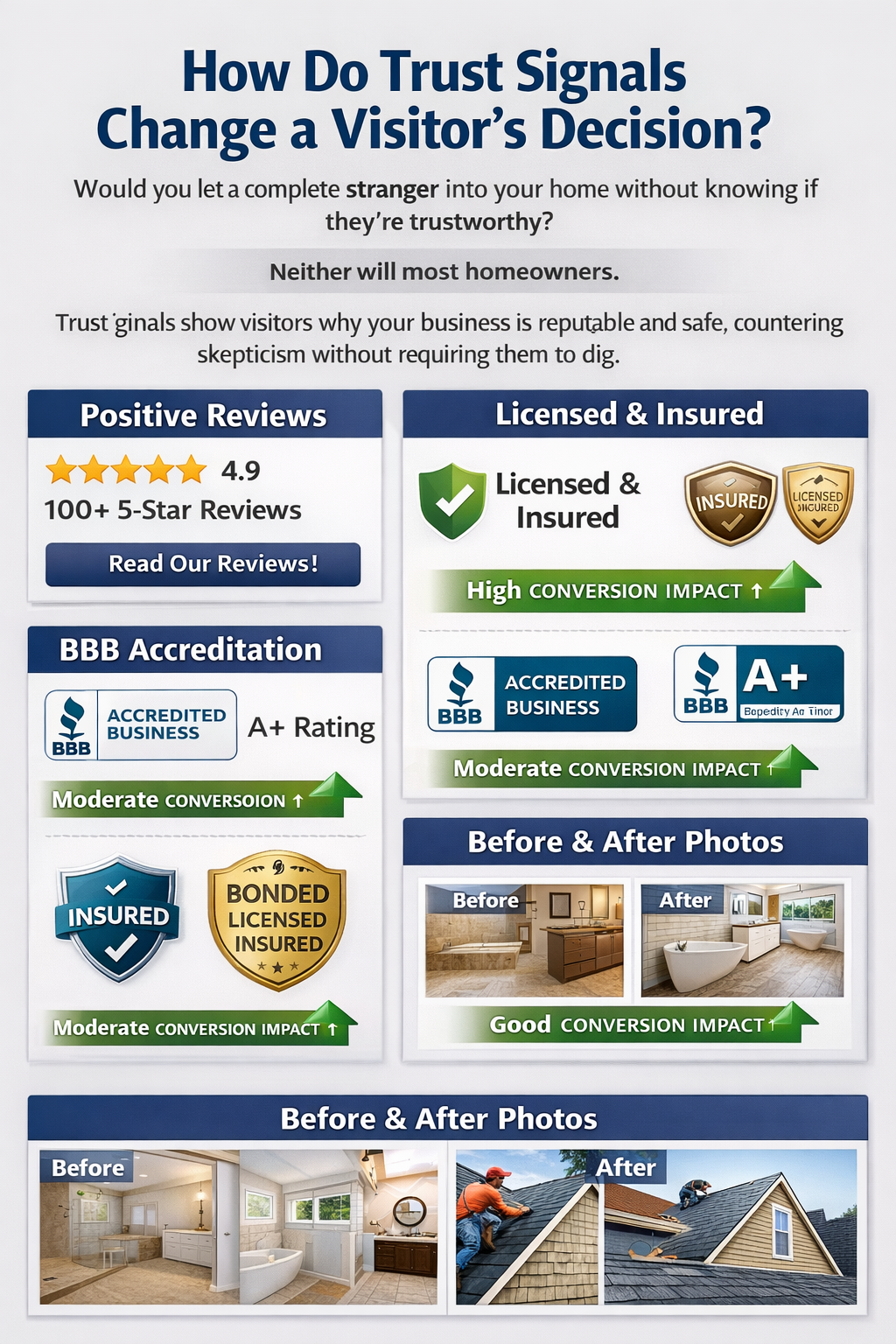
The most effective trust signals for contractor pages include real customer reviews with full names or photos, visible license and insurance information, industry certifications or associations, and project photos that reflect the quality of your actual work. Generic stock photos of smiling workers do the opposite of building trust because visitors recognize them immediately as placeholders rather than proof.
Consumer research in local services categories consistently finds that the presence of verified customer reviews is among the top two or three factors that influence whether a homeowner submits a contact form or calls a business. Pages displaying 10 or more reviews with an average rating above 4.5 stars tend to convert at notably higher rates than those with fewer or no visible reviews.
Where these signals are placed matters as much as whether they’re present at all. Burying your reviews at the bottom of the page means most visitors never see them. The most effective placement for high-impact trust signals is in the top half of the page, close to your primary call to action.
Is Your Call to Action Actually Asking for the Right Thing?
A lot of contractor landing pages have a call to action, but it’s either buried, vague, or competing with five other things the visitor could click. The job of your CTA is to make one specific action obvious and easy. That’s it. When visitors have to hunt for a way to contact you, many of them simply won’t bother.
The language you use in your CTA also carries more weight than most contractors expect. “Submit” is a weak button label because it describes what the visitor has to do rather than what they get. “Get My Free Estimate” or “Request a Same-Day Quote” puts the value front and center. It shifts the framing from asking a favor to offering a benefit.
Repetition matters too. Your CTA should appear at least three times on a typical landing page: near the top above the fold, somewhere in the middle after you’ve built your case, and again at the bottom for visitors who scrolled through everything before deciding. Each placement catches a different type of visitor at a different point in their decision-making process.
What Role Does Page Speed Play in Contractor Lead Generation?
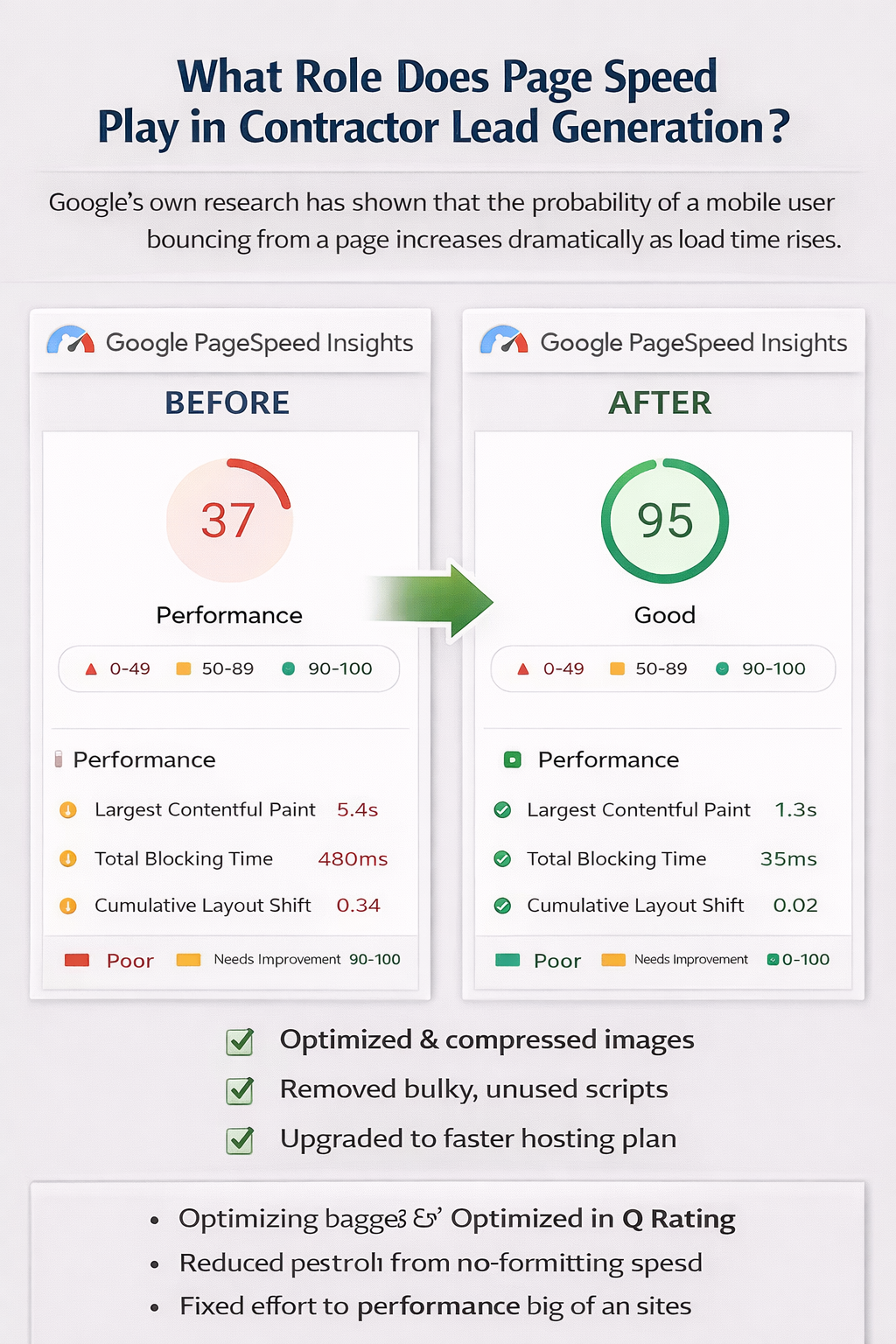
Google’s own research has shown that the probability of a mobile user bouncing from a page increases dramatically as load time rises. Pages that take longer than three seconds to load on mobile devices see bounce rates that can be 50% or more higher than pages loading in under two seconds. For contractors who get the majority of their traffic from mobile searches, a slow page is effectively turning away half their potential leads before those visitors ever see their offer.
This is one of the most underestimated problems on contractor websites. A visually polished page that loads slowly is worse than a plain page that loads instantly, because the slow page trains visitors to associate your brand with frustration before they’ve even read a word about your services. Page speed isn’t a technical detail for developers. It’s a direct conversion factor.
The most common causes of slow contractor pages are oversized image files, bloated website themes with unused scripts, and hosting plans that weren’t built for performance. Most of these can be fixed without redesigning the page at all, and the conversion improvement that follows can be immediate.
How Does Mobile Design Affect Contractor Conversions?
Most homeowners searching for a contractor are doing it from their phone. They’re standing in their kitchen looking at water damage, or they’re in the driveway noticing the roof issue they’ve been putting off. That means your landing page needs to work flawlessly on a small screen, with one hand, in under sixty seconds of attention.
Industry data from home services digital marketing reports suggests that well over 60% of contractor website traffic now originates from mobile devices, with some local service categories seeing mobile traffic shares as high as 75-80%. Businesses with mobile-optimized landing pages consistently generate more leads per 100 visitors than those with pages designed primarily for desktop screens.
Mobile optimization for a contractor page means more than making it technically responsive. It means your phone number is a tappable link at the top of the page. It means your contact form has large, finger-friendly fields. It means your main message is visible without scrolling. These small UX details are what separate pages that convert mobile visitors from pages that frustrate them into leaving.
Does Your Landing Page Copy Sound Like a Human or a Template?
Imagine landing on a contractor’s page and reading: “We provide high-quality roofing solutions for residential and commercial clients with a commitment to excellence and customer satisfaction.” You’ve read that sentence a hundred times before. It says nothing specific, proves nothing, and trusts the reader to fill in all the gaps about why this contractor is worth calling.
Copy that converts reads differently. It speaks to specific situations. It acknowledges the reader’s concern. It gives them a reason to believe. “We’ve repaired over 400 roofs in [City] since 2009, and every job comes with a five-year workmanship warranty” gives the reader three concrete things to hang their trust on: local experience, volume, and accountability. That specificity is what moves someone from interested to ready to call.
The tone matters too. Your page should sound like the person a homeowner would be relieved to call, not like a company brochure. Contractions, plain language, and direct sentences all help. So does addressing the reader as “you” rather than referring to abstract “clients” and “customers.”
Frequently Asked Questions
What are the key elements of a high-converting contractor landing page?
The most important elements are a clear outcome-focused headline, visible trust signals like reviews and licensing information, a specific and repeated call to action, fast mobile load times, and copy written to address the real concerns of a homeowner rather than generic service descriptions. Each element works together to guide a visitor from first impression to submitted form or phone call. Missing even one of these elements can quietly reduce your conversion rate without you realizing it.
How do contractor landing pages turn visitors into leads?
Conversion happens when a page removes uncertainty and makes the next step feel easy and obvious. Visitors arrive with questions they may not even consciously articulate: Can I trust this person? Are they qualified? Will they actually show up? A well-structured landing page answers all of those questions before the visitor has to ask them. The result is a visitor who feels informed and confident enough to reach out rather than continuing to shop around.
What features improve conversion rates on contractor service pages?
Beyond the core elements, features that consistently lift conversion rates include click-to-call buttons, short contact forms that ask only for essential information, a guarantee or warranty statement, a brief “how it works” section that reduces the fear of commitment, and authentic project photos. Video testimonials, when available, can also dramatically increase the time visitors spend on a page and the likelihood they’ll convert.
Who should invest in optimized contractor landing pages?
Any contractor who is spending money on Google Ads, local SEO, or any other form of paid or organic traffic needs an optimized landing page. Sending traffic to a weak page is essentially paying to advertise your competitors, because those visitors will leave and find someone else. Whether you’re a solo operator or running a team of crews, the return on a well-optimized landing page tends to compound over time as it converts a higher percentage of every visitor you send to it.
When is the right time to update or optimize your contractor landing page?
The most obvious trigger is when your traffic is steady but your lead volume isn’t matching it. Other signals include high bounce rates, low time-on-page, a contact form that rarely gets used, or feedback from customers that they had trouble finding your contact information. Beyond reactive fixes, a proactive review of your landing page every six to twelve months keeps it aligned with how your services, pricing, and service area may have evolved.
Your Next Step Toward a Landing Page That Actually Works
Every contractor deserves a landing page that does justice to the quality of their work. The gap between a page that loses leads and one that earns them consistently isn’t about having a bigger budget or a fancier design. It’s about understanding the specific elements that build trust, communicate value, and make it easy for a homeowner to take the next step.
The contractors seeing the strongest results online aren’t necessarily doing more advertising. They’ve built pages that convert a higher percentage of the visitors they already have. That’s where the real leverage is, and it’s available to any contractor willing to treat their landing page as a genuine business asset rather than an afterthought.
If you’re ready to see what a properly optimized contractor landing page can do for your lead flow, the team at GCSherpa specializes in exactly this. Visit gcsherpa.com to learn how they help contractors build pages designed to convert from the ground up.