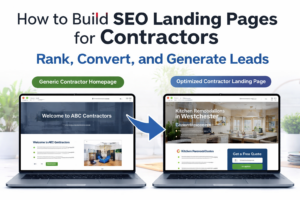

A high-converting SEO landing page combines strategic keyword targeting, compelling service descriptions, and clear calls-to-action to turn search traffic into qualified contractor leads. This guide walks you through designing pages that rank well and convert visitors into paying clients through proven optimization techniques tailored for New York contractor businesses.
Your website gets traffic, but those visitors aren’t calling. They land on your page, scroll for a few seconds, then disappear to a competitor who made it easier to say yes. The problem isn’t your services or your expertise. It’s that your landing page isn’t doing its job.
For contractors competing in markets like New York, where homeowners have dozens of options at their fingertips, a generic service page won’t cut it anymore. You need a landing page that speaks directly to your ideal customer’s needs, shows up when they’re searching, and guides them toward booking a consultation or requesting a quote. That’s what this guide will help you build.
Key Takeaways
- Target specific services and locations: Generic pages get lost in search results, while focused landing pages rank higher and attract qualified leads actively searching for what you offer.
- Lead with clear value propositions: Homeowners need to understand within seconds why you’re the right contractor for their project, not hunt through vague descriptions.
- Optimize for local search intent: New York homeowners search differently than national audiences—your content should reflect regional needs, pricing expectations, and local building considerations.
- Remove friction from conversion: Every extra click, confusing menu, or missing phone number costs you potential clients who’ll move on to competitors with simpler paths to contact.
- Build trust through proof: Before-and-after photos, client testimonials, and clear credentials answer the question every visitor has: “Can I trust this contractor with my project?”
- Test and refine continuously: The most successful contractor landing pages evolve based on real visitor behavior, not assumptions about what should work.
What Makes a Contractor Landing Page Actually Convert?
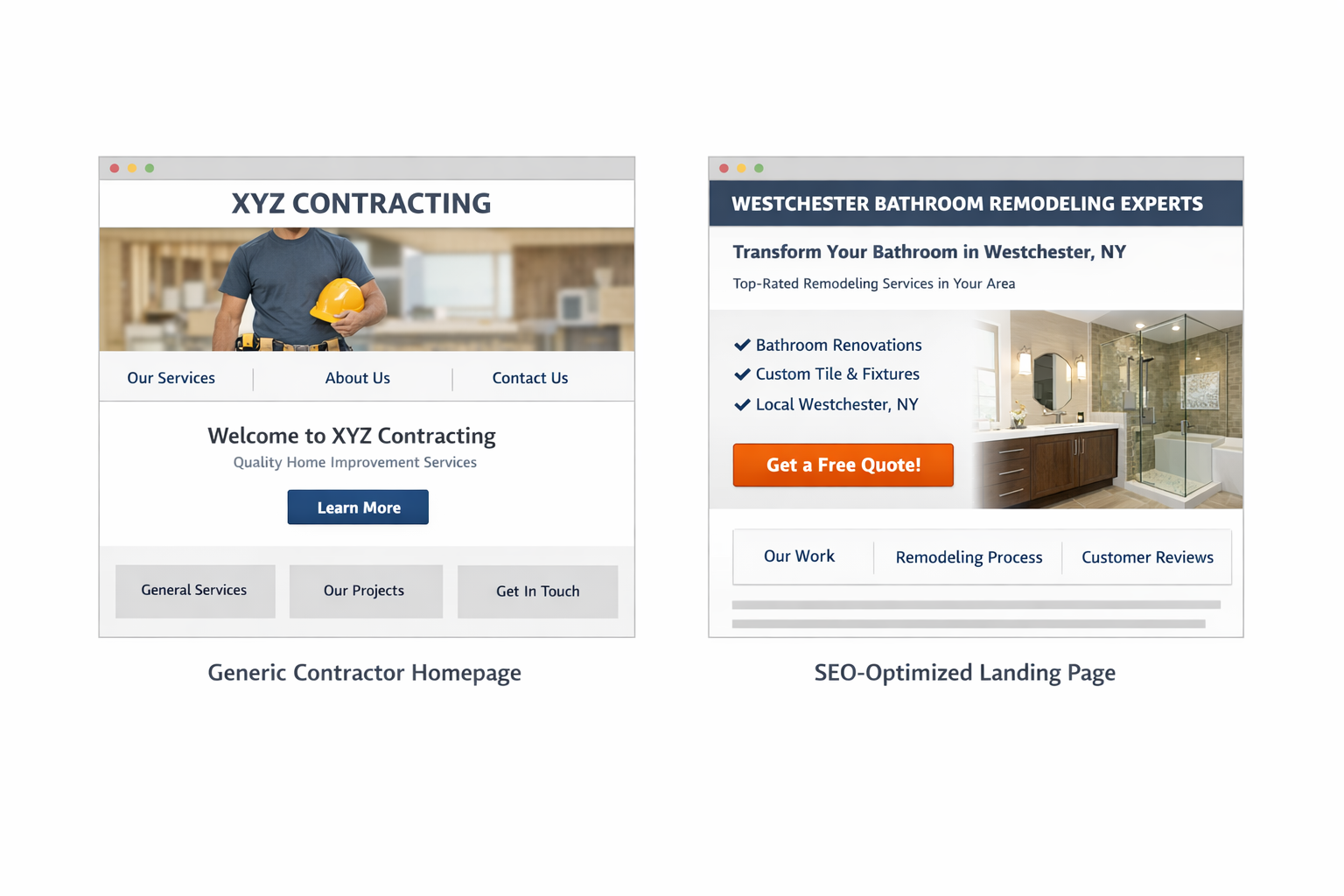
Most contractor websites treat every page the same way. They list services, show a few photos, and hope visitors figure out what to do next. That approach leaves money on the table because it ignores how people actually make hiring decisions.
A high-converting landing page is built around a single goal: moving a visitor from curious browser to qualified lead. It doesn’t try to be everything to everyone. Instead, it focuses on one specific service—like kitchen remodeling, bathroom renovations, or deck construction—and speaks directly to homeowners searching for exactly that.
The difference shows up immediately in performance metrics. Contractors with dedicated landing pages for each major service see conversion rates three to five times higher than those using generic service listings. Visitors spend more time on the page, engage with more content, and complete contact forms at dramatically higher rates.
Think about what happens when a homeowner searches “kitchen remodeling contractor near me.” They’re not browsing casually. They have a specific problem—an outdated kitchen, limited space, poor layout—and they want a contractor who understands that exact challenge. If your landing page speaks to their situation, shows relevant examples, and makes contacting you effortless, you’ll win that lead.
Why Does SEO Matter for Contractor Landing Pages?
You can build the most persuasive landing page in your market, but it won’t generate leads if no one sees it. That’s where search engine optimization becomes critical for contractors.
When homeowners need contractor services, they start with Google. They search for specific terms like “bathroom remodel contractor Westchester” or “deck builder Hudson Valley.” If your landing page doesn’t appear in those results, you’re invisible to potential clients actively looking to hire someone with your exact skillset.
Local search has become the primary way homeowners find contractors, with over 75% of service searches including location terms. Rankings on the first page of Google drive the vast majority of qualified leads, while pages buried on page two or three might as well not exist for most contractors.
SEO for contractor landing pages isn’t about gaming algorithms or stuffing keywords awkwardly into sentences. It’s about creating content that genuinely helps homeowners understand their options while naturally incorporating the terms they’re searching for. When you explain the bathroom remodeling process, discuss timeline expectations, or break down cost factors, you’re simultaneously serving your visitors and signaling to search engines that your page deserves to rank.
The compounding benefit matters too. Paid advertising stops generating leads the moment you stop paying. A well-optimized landing page continues attracting qualified traffic month after month, building momentum as it earns authority and climbs rankings.
How Do You Choose the Right Keywords for Your Landing Page?
Keyword selection separates landing pages that generate steady leads from those that sit dormant. The mistake many contractors make is targeting terms that are either too broad or too competitive to realistically rank for.
Start by thinking like your ideal customer. What specific problem are they trying to solve? A homeowner doesn’t wake up searching for “general contractor.” They search for “kitchen cabinet replacement,” “master bathroom renovation,” or “home addition contractor.” Those specific, service-focused terms become your primary keywords.
Layer in geographic targeting next. If you primarily work in Westchester County, Dutchess County, or specific New York cities, include those locations in your keyword strategy. “Deck builder Westchester County” will attract far more qualified leads for your business than a generic “deck builder” search where you’re competing against contractors across the entire country.
Long-tail keywords that combine service type with location and specific details typically have lower search volumes but convert at rates up to 40% higher than generic terms. Homeowners using these detailed searches know exactly what they want and are ready to hire.
Look at the questions homeowners ask too. Terms like “how much does kitchen remodeling cost” or “how long does bathroom renovation take” represent information-seeking visitors who are earlier in their decision process. Creating content that answers these questions positions you as the trusted expert when they’re ready to hire.
Don’t ignore what’s already working. Check your website analytics to see which search terms currently drive traffic to your site. You might discover unexpected keyword opportunities based on what visitors are actually looking for rather than what you assumed they’d search.
What Content Elements Must Every High-Converting Landing Page Include?
Structure matters as much as substance when building landing pages that convert. Homeowners make quick judgments about whether your page deserves their time, and certain elements need to appear immediately to keep them engaged.
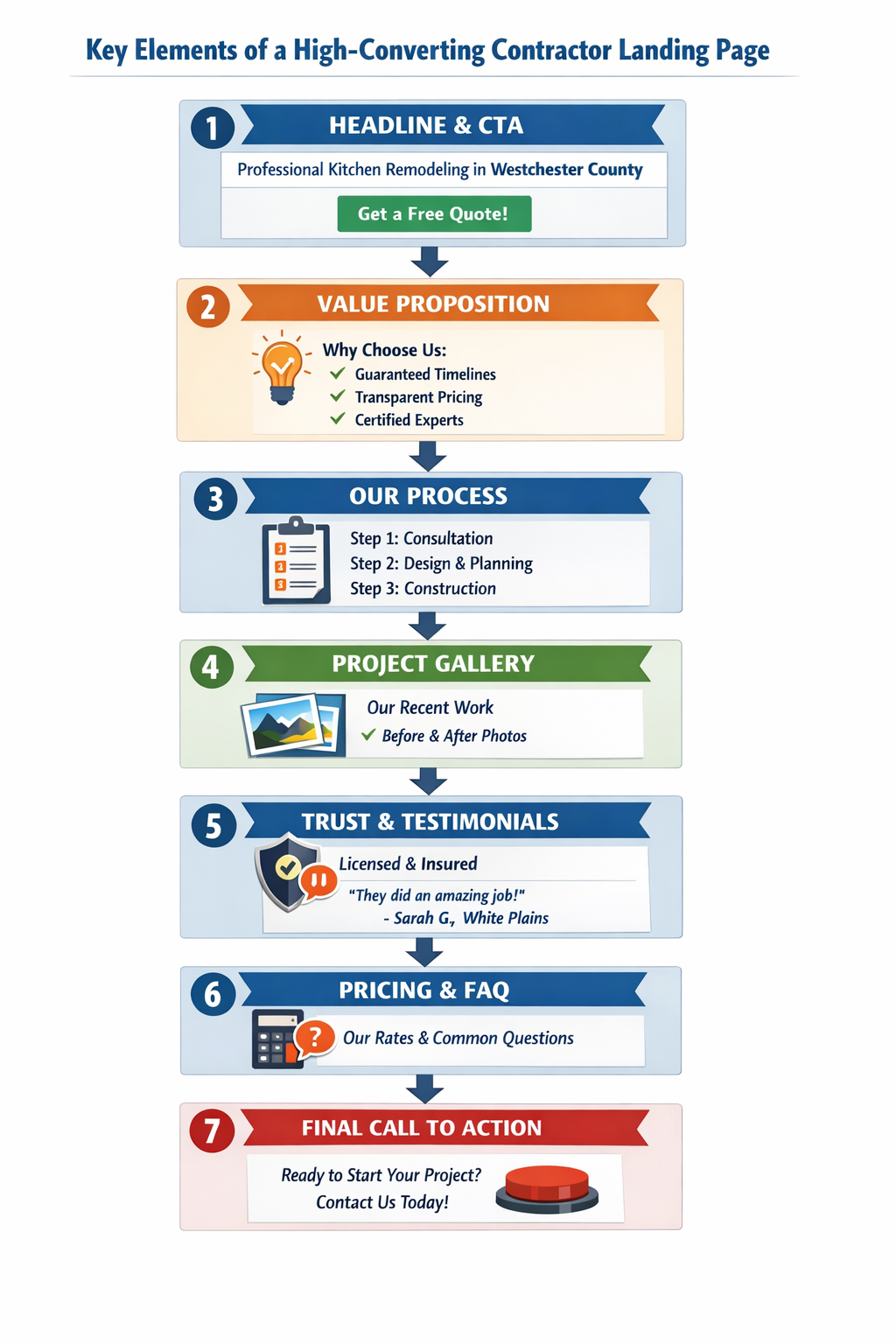
Compelling headline and subheadline: Your H1 tag should clearly state the service and location while promising a specific benefit. “Professional Kitchen Remodeling in Westchester County—Transform Your Space in 6-8 Weeks” tells visitors exactly what you offer and where you work. The subheadline adds supporting details about your unique approach or expertise.
Clear value proposition: Within the first screen view, explain why homeowners should choose your services. This isn’t generic marketing speak about being “the best” or “most trusted.” It’s specific advantages like guaranteed timelines, transparent pricing structures, specialized certifications, or unique design processes that differentiate your work.
Service details and process overview: Homeowners want to understand what working with you actually looks like. Break down your project phases, explain your approach to common challenges, and set realistic expectations about timelines and involvement required from them.
Landing pages that include detailed process explanations see up to 65% higher time-on-page metrics and stronger conversion rates because they reduce anxiety about the unknown aspects of hiring a contractor.
Portfolio examples with context: Photos alone aren’t enough. Every project image should include brief context: the homeowner’s original challenge, your solution, and the results they achieved. This storytelling approach helps visitors visualize their own project rather than just admiring pretty renovations.
Trust signals and credentials: Licensing information, insurance verification, industry certifications, professional affiliations, and years in business all build credibility. Don’t bury this information. Feature it prominently so visitors never have to wonder whether you’re qualified.
Client testimonials and reviews: Specific testimonials from real customers carry more weight than generic praise. The best testimonials mention the service type, describe a challenge you solved, and include the client’s name and location for authenticity.
How Should You Structure Calls-to-Action That Actually Get Responses?
Every element on your landing page should guide visitors toward one specific action. Yet many contractor pages confuse visitors with competing options: “Get a quote,” “Schedule consultation,” “Call now,” “Download our guide,” “View our portfolio.” Each additional choice reduces the likelihood that visitors take any action at all.
Choose one primary conversion goal for each landing page. For most contractor services, that’s getting visitors to request a quote or book an initial consultation. Design your calls-to-action around that single objective.
The strongest CTAs combine specific action language with low-commitment framing. “Schedule Your Free Kitchen Design Consultation” feels less risky to homeowners than “Hire Us Now.” You’re inviting them to a conversation, not demanding an immediate decision about a major investment.
Placement matters just as much as copy. Your primary CTA should appear above the fold, repeated after major content sections, and prominently featured at the end of your page. Some visitors will be ready to convert immediately. Others need to read about your process, see your work, and verify your credentials before they’ll reach out. Place CTAs strategically to capture both.
Multiple strategic CTA placements increase conversion rates by approximately 30% compared to single-location CTAs, as they accommodate different visitor reading patterns and decision timelines.
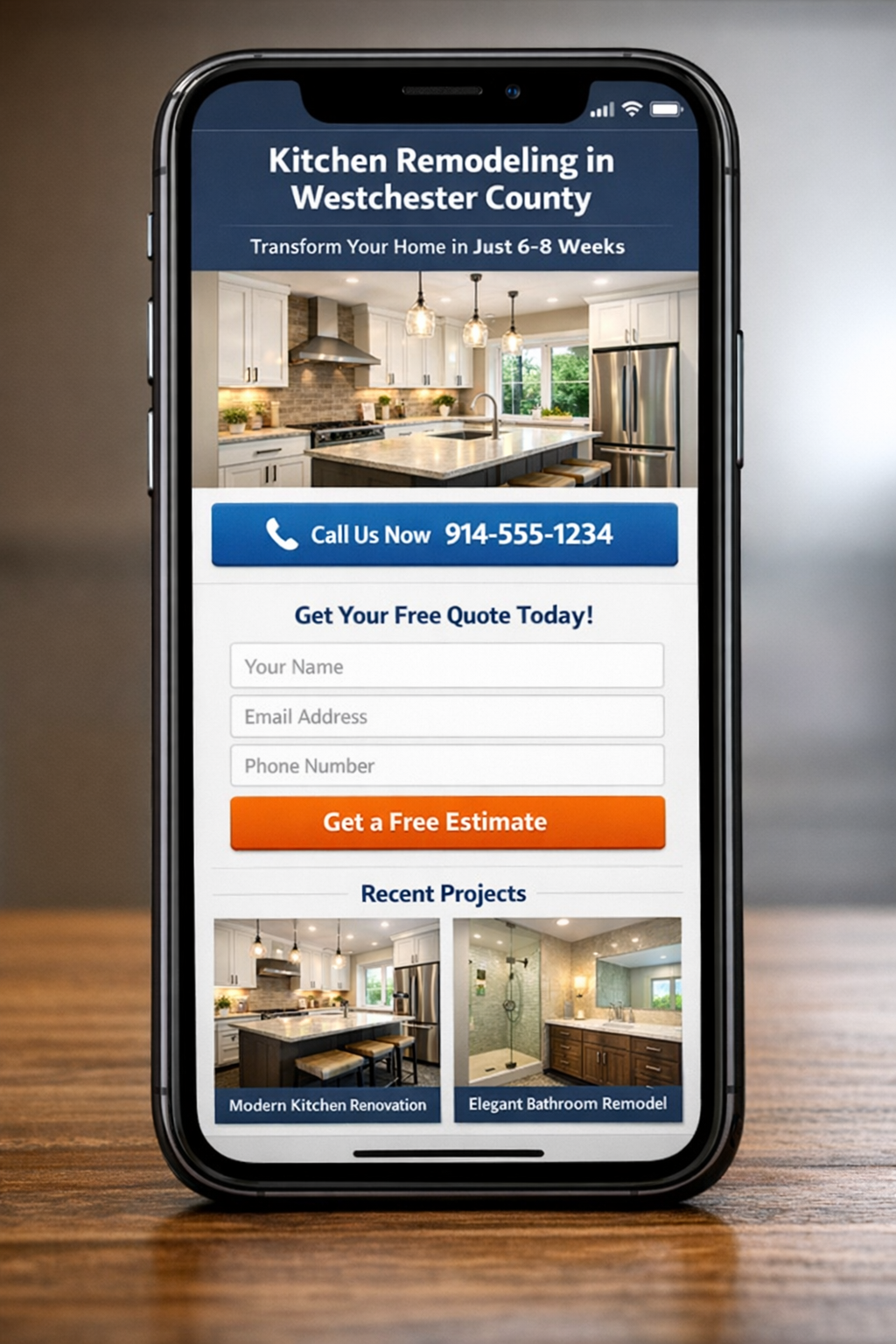
Make contact options obvious and accessible. Your phone number should be clickable on mobile devices and visible in the header throughout the page. Contact forms should be simple—asking only for essential information rather than creating long, intimidating questionnaires that visitors abandon halfway through.
What Role Does Local SEO Play for New York Contractors?
National SEO strategies don’t serve contractors well. Your business depends on homeowners within your service area finding you, not generating traffic from people three states away who’ll never hire you.
Local SEO optimization starts with clear geographic targeting throughout your landing page content. Mention the specific cities, counties, and regions you serve naturally within your copy. When explaining your kitchen remodeling process, reference common considerations for New York homes—older housing stock, specific building codes, climate factors that affect material choices.
Google Business Profile optimization works hand-in-hand with your landing pages. A complete, actively managed profile with current photos, accurate service descriptions, and regular customer reviews signals to Google that you’re a legitimate, active business serving your local area. When someone searches for contractor services near them, Google prioritizes businesses with strong local profiles.
Contractors who actively manage their Google Business Profile alongside optimized landing pages generate approximately 50% more local search leads than those relying on landing pages alone, as the combination improves visibility across both traditional search results and local map packs.
Location pages for multiple service areas extend your reach without diluting your message. If you work across Westchester County, Putnam County, and Dutchess County, create dedicated landing pages for major towns within each region. These aren’t duplicate content—each page addresses the specific characteristics and needs of homeowners in that area.
Local backlinks from area business directories, chambers of commerce, industry associations, and local news sites strengthen your regional authority. Google interprets these links as verification that you’re an established, trusted business within your community.
How Do You Optimize Page Speed and Mobile Experience?
Technical performance determines whether your carefully crafted content ever gets seen. Slow-loading pages lose visitors before they read a single word, and poor mobile experiences frustrate homeowners trying to research contractors on their phones.
Landing pages that load in under three seconds convert at rates more than twice as high as pages taking five or more seconds to display. Every additional second of delay increases bounce rates by approximately 10%, directly reducing the number of leads generated from your traffic.
Image optimization offers the fastest performance improvement for most contractor websites. High-resolution project photos provide impressive visual proof but can bloat page sizes to unusable levels. Compress images to balance quality and file size, use modern formats like WebP, and implement lazy loading so images only download as visitors scroll to them.
Mobile-first design isn’t optional anymore. Most homeowners will view your landing page on a smartphone, especially if they found you through local search. Your mobile experience needs to be seamless: readable text without zooming, easily tappable buttons and phone numbers, forms that work smoothly on small screens, and navigation that makes sense without hover states.
Test your landing pages on actual devices, not just desktop browser tools that simulate mobile views. You’ll quickly discover issues that don’t show up in simulated testing—buttons too small to tap accurately, forms that trigger awkward keyboard behaviors, or images that don’t scale properly.
What Testing and Refinement Should You Do After Launch?
Launching your landing page is just the beginning. The most successful contractor pages evolve continuously based on real visitor behavior and conversion data.
Start by establishing baseline metrics. Track your current conversion rate, average time on page, bounce rate, and traffic sources. These numbers tell you how well your initial design performs and give you a reference point for measuring improvement.
Test one element at a time to understand what actually drives results. Try different headline variations, adjust your CTA copy, experiment with form field requirements, or test alternative layouts for your portfolio section. Change multiple elements simultaneously and you won’t know which modification affected your results.
Continuous testing and optimization typically improves landing page conversion rates by 20-30% over a six-month period as contractors identify and fix friction points that initially went unnoticed.
Heat mapping tools reveal how visitors actually interact with your page. You might discover that people aren’t scrolling far enough to see important information, that they’re trying to click elements that aren’t actually clickable, or that certain sections get ignored completely. This behavioral data guides smarter redesign decisions than guesswork alone.
Gather qualitative feedback alongside quantitative data. When leads contact you, ask how they found your site and what information proved most helpful. You’ll learn which content elements build trust and which concerns aren’t adequately addressed on your landing page.
Frequently Asked Questions
What is a high-converting SEO landing page for contractor services?
A high-converting SEO landing page for contractor services is a web page designed to attract potential customers through search engines and encourage them to take action, such as requesting a quote, booking a consultation, or contacting the contractor. It combines strategic keyword targeting with persuasive design elements that address homeowner needs and guide visitors toward becoming clients. The page focuses on one specific service rather than trying to cover everything your business offers.
How does an SEO landing page work for contractors?
It works by combining search engine optimization (SEO) strategies with persuasive design elements. The page targets specific keywords, provides helpful information about the contractor’s services, and includes clear calls-to-action that guide visitors toward becoming leads or customers. When homeowners search for services you offer, your optimized landing page appears in search results, attracts qualified traffic, and converts those visitors through strategic content and design that builds trust and reduces friction.
What are the main benefits of SEO landing pages for contractors?
The main benefits include higher search engine visibility, more qualified leads, improved conversion rates, better user experience, and increased trust through testimonials, service details, and clear contact options. Unlike general marketing that reaches broad audiences, SEO landing pages attract homeowners actively searching for your specific services in your service area. They generate leads continuously without ongoing advertising costs and compound in effectiveness as they build authority over time.
How can contractors use SEO landing pages effectively?
Contractors can use SEO landing pages to promote specific services, target local customers, highlight expertise, and convert website visitors into inquiries, appointments, or project requests. Create dedicated pages for each major service you offer rather than grouping everything together. Optimize each page for the specific keywords homeowners use when searching for that service in your area. Then drive traffic through local SEO, Google Business Profile optimization, and strategic content marketing that positions you as the expert solution.
When is the best time to create an SEO landing page for contractor services?
The best time to use an SEO landing page is when launching a new contractor service, targeting a new location, running marketing campaigns, or improving website performance to generate more leads from organic search. If your current website generates traffic but few conversions, dedicated landing pages can dramatically improve results. Contractors expanding into new service areas benefit from location-specific landing pages that speak directly to homeowners in those regions. The reality is that there’s rarely a wrong time—most contractors would benefit from optimized landing pages immediately.
Start Converting More Visitors Into Clients Today
Your expertise deserves better than a generic website that lets qualified leads slip away to competitors. A strategic, well-optimized landing page transforms how homeowners perceive your business and dramatically increases the percentage of visitors who actually reach out.
The contractors winning in competitive markets like New York aren’t necessarily more skilled at their craft. They’ve simply made it easier for homeowners to find them, understand what makes them different, and take that first step toward working together. Your landing page becomes your hardest-working sales tool—attracting qualified traffic around the clock and converting browsers into booked consultations.
Building effective landing pages requires understanding both the technical optimization that drives rankings and the persuasive elements that convert visitors. It’s not about stuffing keywords awkwardly into content or creating flashy designs that distract from your message. It’s about strategic clarity: showing up when homeowners search for what you offer, immediately communicating your value, and removing every obstacle between interest and contact.
If you’re ready to stop losing leads to poorly designed web pages, GC. Sherpa helps New York contractors build landing pages that actually generate business. We understand the local market dynamics, the questions homeowners ask before hiring, and the optimization strategies that drive both rankings and conversions. Call (845) 533-3309 to discuss how strategic landing pages can transform your lead generation and grow your contracting business consistently.