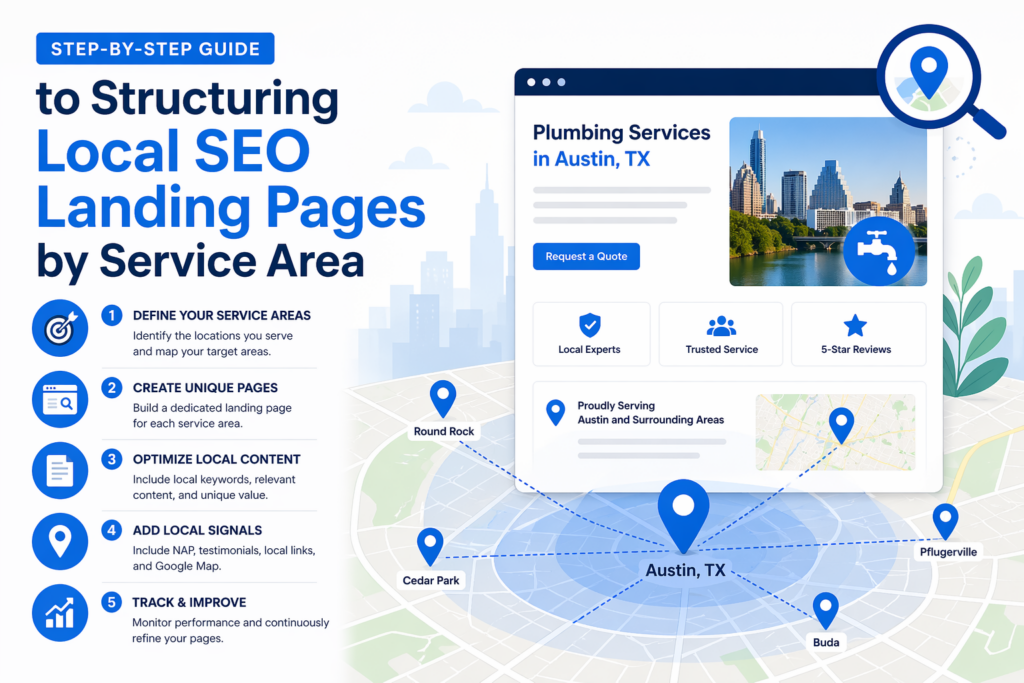
Structuring local SEO landing pages by service area is one of the most reliable ways to capture high-intent search traffic from specific towns, neighborhoods, or counties. This guide walks through every stage of building these pages correctly, from URL architecture and on-page signals to content strategy and conversion elements, so your business shows up where it matters most.
If your service business covers multiple towns or zip codes but you’re only ranking in one place, you’re leaving real revenue on the table. Most companies build one generic homepage and hope it does all the heavy lifting. It doesn’t. Search engines want to see clear, dedicated evidence that you actually serve a specific area, and that evidence needs to live on its own page.
Key Takeaways
- Each service area you target deserves its own dedicated landing page with unique, locally relevant content.
- URL structure, page titles, and headers must all reflect the specific city or region you’re targeting.
- Thin or duplicate service area pages can harm your rankings rather than help them.
- Local schema markup and NAP consistency are non-negotiable for pages targeting geographic terms.
- Strong calls to action with local context convert better than generic contact forms.
- A well-structured service area page serves both search engines and real people looking for local help.
Why Do Generic Service Pages Fail at Local Search?
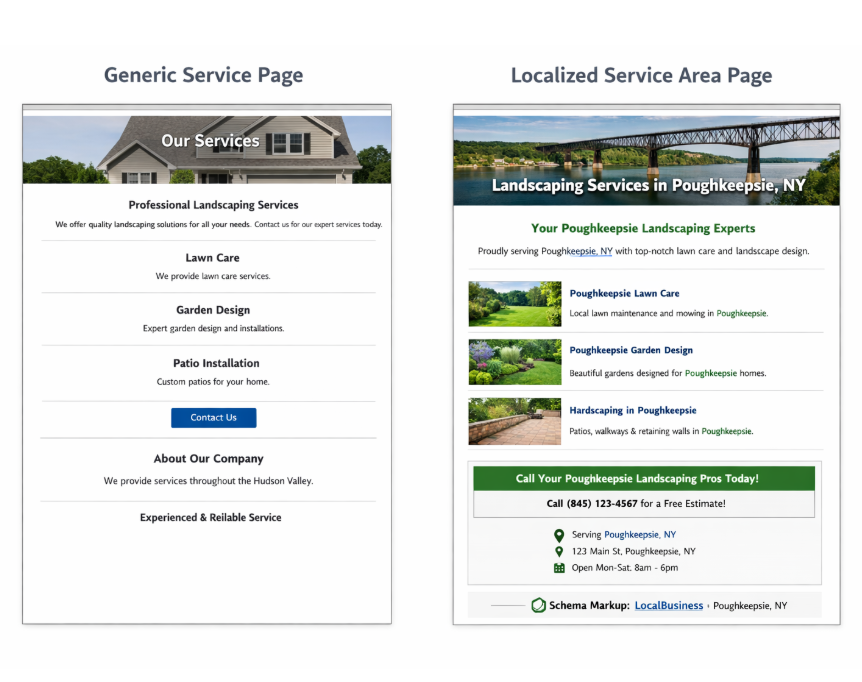
The problem with a single service page is simple: Google can’t confidently serve it to someone in Poughkeepsie if it has no signals connecting it to Poughkeepsie. Search intent at the local level is highly specific. When someone types “plumber in Newburgh NY” or “roof repair near Kingston,” they expect to see a page that speaks directly to their location, not a broad company overview.
Research consistently shows that local intent makes up nearly half of all Google searches, and among those, a significant percentage result in a phone call or store visit within 24 hours. That means showing up for local queries isn’t just an SEO win, it’s a direct line to revenue.
Generic pages don’t just underperform. They actively miss opportunities. If you’re a landscaping company covering six towns across the Hudson Valley but you only have one service page, you’re competing against businesses that built dedicated pages for each of those towns. Those competitors will almost always outrank you in those specific locations.
How Should You Set Up Your URL and Site Architecture?
Before writing a single word of content, get your URL structure right. A clean, logical architecture signals to search engines that your site is organized and authoritative. For service area pages, the two most widely recommended approaches are subfolder structures and subdirectory patterns.
A subfolder setup looks like this: yoursite.com/service-area/kingston-ny/ or yoursite.com/locations/newburgh/. This keeps everything under your root domain, passing authority from your homepage down to each location page. Avoid subdomains like kingston.yoursite.com for service area pages because they’re treated as separate websites by search engines and dilute your domain authority.
SEO practitioners widely recommend keeping service area pages in a consistent subfolder hierarchy as a best practice for crawlability and link equity distribution. Sites that use clear subfolder structures for location pages tend to see stronger indexation rates and more predictable ranking performance across geographic targets.
Your URL slug should include both the service type and the location name wherever possible. Something like /drain-cleaning-poughkeepsie-ny/ gives Google a clear, immediate signal about what the page covers and where it’s relevant. Keep slugs lowercase, hyphen-separated, and free of unnecessary stop words.
What Goes Into a High-Performing Service Area Page?
This is where most businesses either get it right or fall flat. The structure of each service area page needs to hit several key elements to rank well and convert visitors into leads. Think of it as building a case: you need geographic relevance, topical depth, and a compelling reason to act.
Title tag and H1 alignment: Your page title should contain the primary service keyword and the location name. The H1 on the page should match closely but doesn’t need to be identical. Something like “Roof Replacement Services in Kingston, NY” works well as a title, while the H1 might read “Kingston’s Trusted Roof Replacement Specialists.” Both hit the same signals without feeling robotic.
Opening section that earns attention locally: The first 100 to 150 words of your page should speak directly to the reader’s location and situation. Reference the area naturally. Mention something specific about that community, the housing stock, local weather patterns that affect the service, or the types of neighborhoods you typically work in. Vague opening paragraphs get bounced fast.
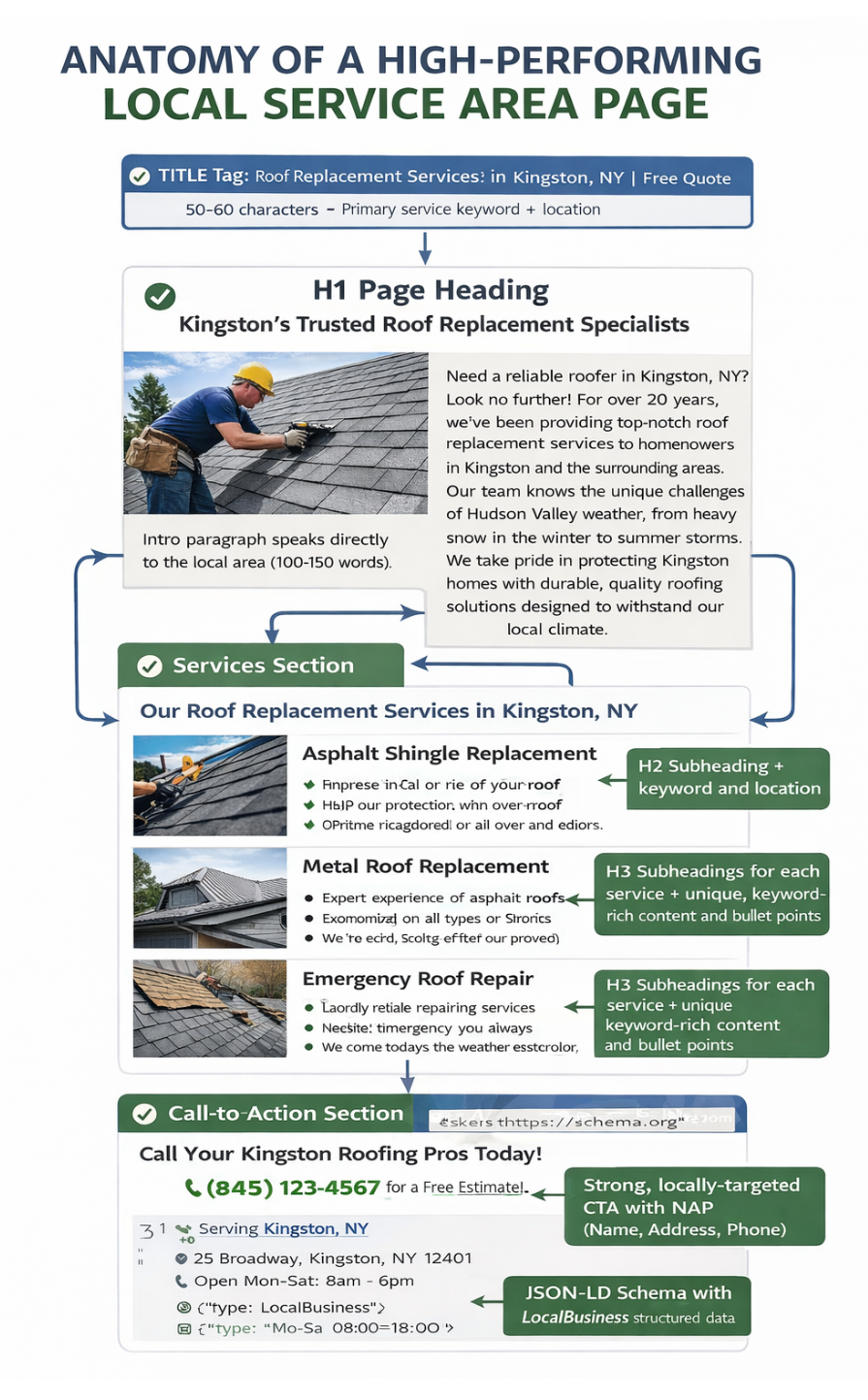
Service-specific body content: Each page needs at least 400 to 600 words of unique content describing the service in the context of that location. Don’t copy your main service page and swap in a city name. Search engines detect near-duplicate content, and it won’t rank. Talk about local considerations, seasonal factors specific to the region, typical project scopes in that area, and anything else that makes the content genuinely useful for someone in that town.
Local social proof: A review or testimonial from a customer in or near that specific city carries more weight than a generic five-star rating. If you can pull a quote from a Kingston customer for your Kingston page, do it. It builds trust with readers and reinforces geographic relevance to search engines.
Why Does Schema Markup Matter for Local Landing Pages?
Schema markup, particularly LocalBusiness and Service schema, helps search engines parse structured information about your business without ambiguity. Pages that implement valid schema markup have been shown to achieve richer search result appearances and improved click-through rates compared to pages without structured data.
At a minimum, each service area page should include LocalBusiness schema with your business name, address, phone number, and service area. If the page targets a specific service type, layer in Service schema that describes what you do, for whom, and where. Keep your NAP (name, address, phone number) consistent across every page and matching exactly what appears in your Google Business Profile.
Schema isn’t visible to your human visitors, but it’s one of the clearest signals you can give to search engines and AI-powered answer systems about who you are, what you offer, and where you operate. Given how much search is shifting toward AI-generated responses, having clean, complete structured data is no longer optional for any serious local SEO strategy.
How Do You Avoid the Duplicate Content Trap?
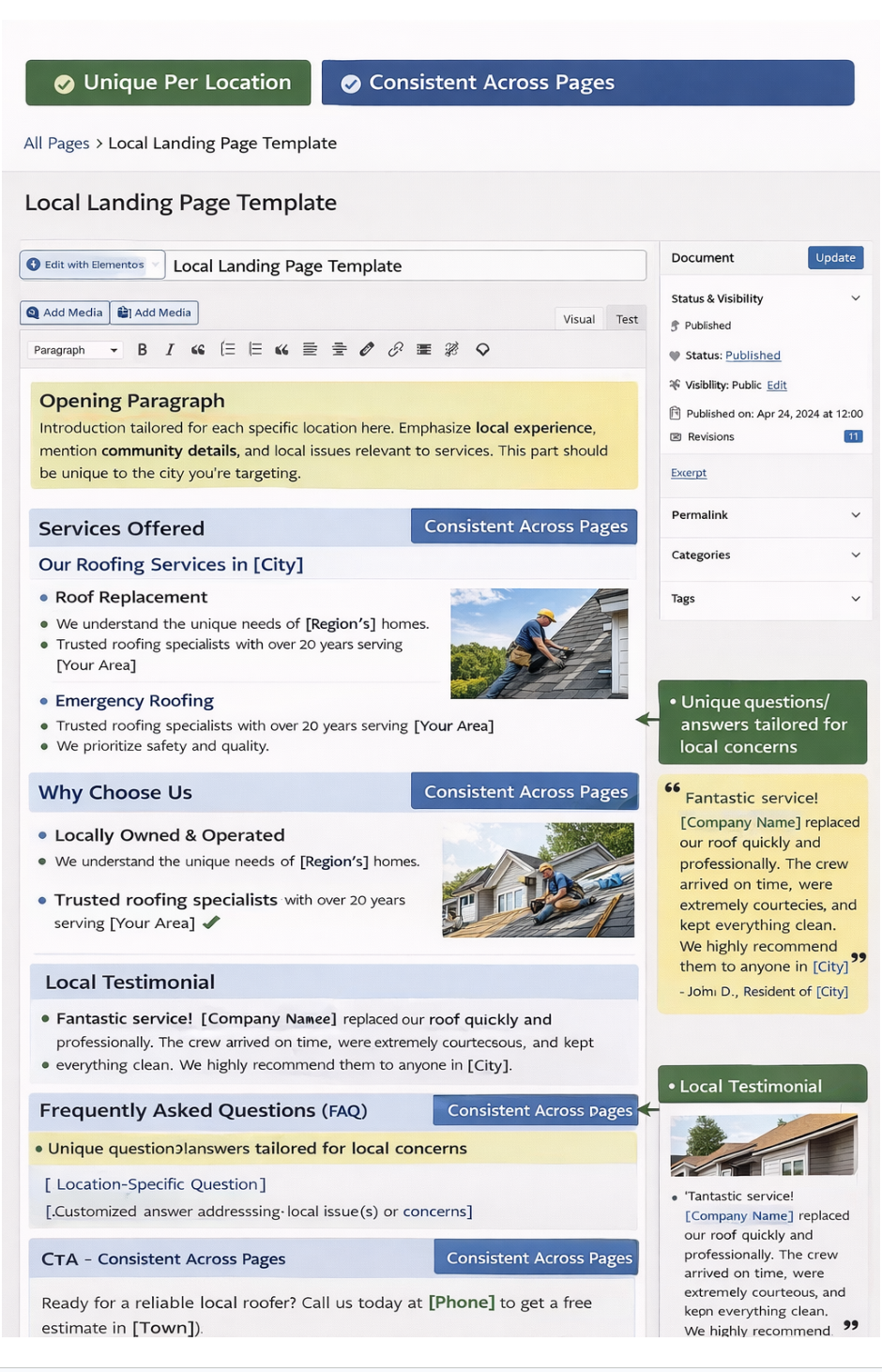
This is the question that trips up almost every multi-location business. You need 10 pages for 10 towns, but you don’t want to write 10 completely different articles from scratch. The answer is a modular content strategy that keeps the core structure consistent while swapping in genuinely unique elements for each location.
Standardize your page template: opening paragraph, services offered, why choose us, local testimonial, FAQ, CTA. Then customize the opening paragraph, the testimonial, any locally relevant details, and the FAQ answers based on questions specific to that area. That approach gives you efficiency without sacrificing uniqueness.
Thin or near-duplicate local landing pages have historically been targeted in Google quality updates, with affected sites experiencing significant drops in organic visibility. Pages that offer unique, location-specific value consistently outperform templated content across local search verticals.
One practical shortcut: write one deeply detailed page for your primary city first. Use that as your benchmark for quality and depth. Then build each subsequent location page at that same standard. Never launch a page that you yourself wouldn’t find useful if you were searching for
What Role Do Internal Links and Navigation Play?
Your service area pages shouldn’t exist in isolation. They need to be discoverable from your main navigation or a dedicated “Areas We Serve” section, and they should link to and from your core service pages. This internal link structure passes authority, helps search engines understand the relationship between your content, and makes the user experience feel logical rather than fragmented.
A footer with a clean list of service areas, each linking to its dedicated page, is one of the most effective and underused local SEO tools out there. It keeps every location page accessible within one or two clicks from anywhere on the site, which is exactly what both users and crawlers want to see.
Frequently Asked Questions
What is a step-by-step approach to structuring local SEO landing pages by service area?
A step-by-step approach starts with defining your service areas, then building a clean URL structure with one dedicated page per location. Each page needs a keyword-aligned title tag, unique locally relevant body content, LocalBusiness schema, consistent NAP data, and a clear call to action. The goal is to give search engines and potential customers a complete, trustworthy picture of your services in each specific location.
How does structuring local SEO landing pages by service area improve search rankings?
When search engines crawl a dedicated page built around a specific town or county, they have clear, unambiguous signals to serve that page to searchers in that location. Without dedicated pages, your site competes on vague geographic proximity alone. Structured service area pages give you a real ranking asset for each location rather than relying on your homepage to do everything at once.
What are the main benefits of using a structured approach for service area landing pages?
The most immediate benefit is stronger visibility in localized searches across every town you serve. Beyond rankings, well-structured pages convert better because they speak directly to the reader’s location and situation. They also build topical authority over time, making your domain more competitive in the local results as you add more pages and earn more local backlinks and citations.
Who should use a step-by-step guide for local SEO landing page structure?
Any service business that operates across multiple cities, towns, or zip codes can benefit from this approach. This includes contractors, healthcare providers, legal and financial professionals, home service companies, and any B2B service provider targeting a regional market. The more geographic ground you cover, the more critical it becomes to have dedicated, well-structured pages for each area.
When is the best time to implement structured service area landing pages for SEO?
The best time is before you need the traffic, since local pages typically take several weeks to months to gain traction in organic results. If you’re launching a new service area or expanding your coverage territory, build the landing pages as part of the launch, not after. For existing businesses, auditing and restructuring current location pages before a busy season is the most strategic approach.
Ready to Build Local Pages That Actually Rank?
Imagine opening Google Search Console three months from now and seeing organic traffic coming in from Middletown, from Goshen, from Beacon, from towns you’ve been trying to reach for years with nothing to show for it. That’s what happens when your site finally has the right structure in place. Each page does its own work, targeting its own audience, pulling in its own traffic.
The framework laid out in this guide gives you everything you need to get started. Clean URL architecture, unique locally relevant content, proper schema markup, consistent NAP data, internal linking that ties it all together. None of it is complicated on its own. What matters is doing all of it consistently and not cutting corners on content quality.
At GC Sherpa, we work with service businesses across New York to build local SEO strategies that translate directly into phone calls and booked jobs. If you’re ready to stop guessing and start showing up in the towns that matter most to your business, reach out to our team. Call us at (845) 533-3309 and let’s build something that actually works.